

These 8 powerful business storytelling frameworks can help you captivate your B2B audience. Learn how to craft compelling narratives that drive results – and sales.
Everyone loves a good story. When you tell a great business story, your goal is to enable the person listening to see their lives playing out in your story.
Quick note: Here’s how I wrote this 2500-word article in 30 minutes using MakeMEDIA: 1) it generated an outline and interviewed me, 2) I simply spoke to it, 3) it wrote the first draft based entirely on my interview responses (total time: 20 minutes). Then, I made a few edits and added images before publishing (another 10 minutes). MakeMEDIA reduced what was normally 10 hours of work down to 30 minutes total.
Table of Contents
Business Storytelling Frameworks
Stories help us retain information. When someone explains something in the form of a story, it creates an image in our minds that enables much faster recall. Business storytelling is also effective in motivating people to make a behavioral change. When they can relate to a story, they get a better understanding of why they should hire you, and that influences their decision-making.
And if you’re an executive, you’ll enjoy our detailed guide to see how business storytelling frameworks can fit into your overall content marketing plan:
You'll also love our other guides:

CEOs Guide to Content Marketing

B2B Storytelling: How Executives Find and Tell Great Stories
(Inside secrets from a former TODAY Show producer)

Emmy Winner’s Storytelling Hook Examples That Grab Attention in 3 Seconds
1. The Hero Framework in Business Storytelling

The hero’s journey is a powerful business storytelling framework that we’ve all experienced. In this framework, there are three characters: the hero, the Sherpa or guide, and the villain.
In business terms, your customer is always the hero, never you. You, the company, are the sherpa, the guide. The villain is the problem that your customer is trying to solve.
Take the example of Star Wars. Luke Skywalker was the hero, Yoda or Obi-Wan Kenobi was the sherpa, and Darth Vader was the villain. In a business context, you use your expertise and knowledge as the Sherpa to guide your customer to overcome the villain.
Apple’s 1984 commercial that introduced the Macintosh is another great example of the hero’s journey in action. The hero was represented by the athlete throwing a hammer into a TV screen, breaking it. The villain was conformity, dominance by IBM, and the status quo. When the screen shattered, all the people watching suddenly came alive.
They were the heroes in that story, liberated by the Macintosh. The Macintosh was the guide – not the hero – that enabled the whole story to unfold. Your products and services are the guide for your clients, who are the heroes.
2. The Pixar Pitch
The Pixar pitch is a very concise business storytelling technique because it uses just six sentences. It’s taken from the motion picture studio Pixar. The way it works is that the first sentence starts to set the scene and introduces the protagonist. Then you start to establish a conflict or a challenge, outline what the journey looks like, and then the resolution, all in six sentences, so it’s pretty quick.

In the conflict and resolution of business stories, you want to make sure that you engage the stakeholders by identifying pain points they can relate to, showcasing problem-solving approaches, and highlighting the positive outcomes. You can change the Pixar pitch based on who you’re talking to, such as investors, customers, or even your own employees.
Here’s an example of what a Pixar pitch would sound like for a product called QuickBooks that many of us use for accounting:
- Once upon a time, small businesses struggled with complex accounting.
- Every day, they wasted hours on bookkeeping.
- One day, QuickBooks was created.
- Because of that, small business owners could easily manage their finances.
- And because of that, they saved time and money.
- Finally, they could focus on growing their businesses instead of drowning in paperwork.
This reads like a fairy tale, but in the context of using it in a business environment, you wouldn’t use the fairy tale aspects, words like “once upon a time” or “one day.” You would just strip those out and start talking about the main key points, like this:
- Small businesses struggled with complex accounting.
- They waste hours on bookkeeping.
- That’s why QuickBooks was created.
- What this enabled small business owners to do is easily manage their finances, and that saved them time and money
- So they can focus on growing their businesses instead of drowning in paperwork.
3. The Three-Act Structure
The three-act structure is a classic business storytelling tactic. The three parts of it are the setup, the confrontation, and the resolution.

In the setup, you introduce the characters and deal with the status quo. In the confrontation stage, you start presenting the challenges and obstacles that need to be overcome, similar to the hero’s journey. Finally, in the resolution part, you showcase the solutions and the outcomes.
To captivate your audience, it’s important to build tension and lead to a climax where they can see the resolution. Build up anticipation and pace it to make the story more dramatic. The three-act structure is commonly used in sales presentations, business pitches, and even in branding your advertising.
A good example of the three-act structure is Airbnb’s Wall and Chain video:
- In the setup (Act 1), a former East German guard reminisces about his past.
- In the confrontation (Act 2), he struggles with guilt and the desire to revisit Berlin.
- In the resolution (Act 3), he uses Airbnb to visit Berlin and meets a young German host, finding closure.
Remember to pull emotion into your story. Emotions help you make people feel what you want them to feel, which is a positive feeling about your product.
4. The Nested Loop Technique
The nested loop is a popular business storytelling framework that starts with a concept and then drills down, constantly referencing the main concept. You create multiple interconnected stories that layer in depth, provide examples, and offer solutions, all tying back to one main concept. This approach ensures everything feels cohesive.
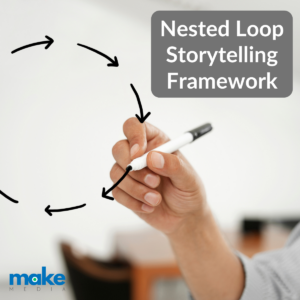
The key to the nested loop technique is layering the messages. You can use nested loops in various business contexts, such as annual reports, investor presentations, marketing presentations, training, or educational materials. By constantly referring back to one message, you maintain a consistent theme throughout your storytelling.
Salesforce provides a great business storytelling example of how to use nested loops in their Dreamforce keynotes. They might choose a main theme, like digital transformation, and within that, they nest customer success stories, product demonstrations, and industry trends. All of these elements connect back to the central theme of innovation and customer success, tied to digital transformation.
If you’re presenting at a customer conference, the nested loop business storytelling technique is a great way to weave a story throughout various presentations during the day, constantly referring back to the main theme.
5. The Sparkline Method for Inspirational Business Stories
The Sparkline is a framework that motivates your audience to embrace change by contrasting what is with what could be, creating a compelling vision. This framework starts by analyzing current situations and pain points, then paints a picture. The visual image you create for people helps illustrate the story and how their life as it is now can be significantly better by using your services or buying your products. You tie it all together through the Sparkline, which is the path to get to that positive change.

The tactic behind the Sparkline method is to use emotion, emotive language, and imagery. Present things in clear, logical, and achievable steps, then emphasize the personal, group, and corporate benefits they will get by making this change.
You can use the Sparkline technique to help with management initiatives and to encourage clients to adopt products and services.
Tesla’s mission statement is an example of a Sparkline framework. It says, “to accelerate the world’s transition to sustainable energy.” In such a short sentence, it contrasts our current reliance on fossil fuels with a vision of what a sustainable future could look like. The idea behind this statement is to inspire action toward achieving that goal.
6. In Medias Res: Starting a Business Story in the Middle
In Medias Res is one of my favorite techniques, where you start the story in the middle. For example, if you are a cybersecurity consultant, you might tell a story like this:
- “The CEO received a text in the middle of the night that read, ‘all systems are down, we’re under attack.'”

The interesting thing about starting with this line is that it begins in the middle of the story, allowing you to go back and explain how this all came about, what the cybersecurity risks are, and how the hackers got in. Then, you can move forward to show how the resolution came to be and what you, as the service provider or product developer, did to resolve the situation.
Starting in the middle of the story, right at the point of climax or pain, is a beautiful way to captivate your audience very quickly with just one line. It creates intrigue, making people want to know what happened. They’ll be curious about how the situation got to that point and what you did to fix it.
In Medias Res is a powerful way to start a presentation, especially if you’re delivering one at a conference or making a video.
It’s one of my favorite business storytelling tactics.
7. Freytag’s Pyramid Storytelling Method
Freytag’s Pyramid is a comprehensive business storytelling framework with five parts. It’s a dramatic structure that creates well-rounded stories by including various elements. The five parts are:
- Exposition: Set the scene and introduce key elements about the scene.
- Rising Action: Build tension, which gets people interested.
- Climax: Reach the peak moment, which could be a revelation.
- Falling Action: Show the gradual consequences of the climax or revelation.
- Denouement: Provide resolution and closure on the story.

In a business context, your goal is to build up tension and provide a release at the end, allowing people to see the resolution to their situation and understand the benefits of your solution.
This framework is well-suited for long-form content like white papers, case studies, speeches, and presentations.
An example of a B2B story using Freytag’s Pyramid:
- A logistics company is plagued by inefficiencies. They discover a SaaS provider called LogiSolve at a trade conference, and the CEO is intrigued by the potential for optimization and automation (exposition).
- Despite initial team resistance, they decide to pilot the software (rising action).
- A major shipment goes awry due to a system error in their old process, causing havoc (climax).
- They switch to LogiSolve’s platform, which resolves the issue quickly and prevents future occurrences, convincing the team of its effectiveness (falling action).
- The company sees improvements in inventory errors, delivery times, and customer satisfaction, leading them to become a loyal customer of LogiSolve, enabling significant growth (denouement).
8. ABT: And, But, Therefore Storytelling Framework
The ABT (And, But, Therefore) framework is a condensed version of the Freytag framework, with three steps instead of five. The “and” part establishes the context and talks about the status quo. The “but” part introduces the conflict and the challenge. Finally, the “therefore” part presents the solution and the resolution.

The main component of the ABT framework is its brevity, allowing you to tell a story very quickly. This makes it ideal for elevator pitches, quick presentations, social media posts, or short content like product descriptions or company value propositions. When using this framework, be sure that you have a logical progression of ideas.
Here’s an example using the company from the previous framework:
- And: A prospect is trying to expand their market reach by improving the customer experience through faster delivery times and better inventory management.
- But: Their current logistics system is outdated and can’t handle the increase in demand, causing delays and customer dissatisfaction.
- Therefore: They partner with a logistics company that specializes in these solutions to implement an advanced software platform that optimizes their supply chain. As a result, they see a 30% increase in delivery speed and a significant boost in customer satisfaction, helping them achieve their growth goals.
Use the ABT framework when you want to tell a story very quickly and concisely.
How to Capture Client Stories
My favorite way to capture a client story is to invite a customer to a video call and ask their permission to record your conversation. Then, ask them this question:
“Tell me about a time when…”
The only way to answer this question is by telling a story.

For example, “Tell me about a time when one of your clients logged into your software. What were they trying to do that day?” Their answer becomes a story you can use (get their permission first).
When you record on video, you can repurpose it in numerous ways:
- Create video clips
- Take the transcript and create an article
- Combine the article and video clips to make a social media post
All of these enhance your reach because you want to reach people where they are, whether it’s YouTube, LinkedIn, or even TikTok if that’s where you audience hangs out. You want to reach people where they are, not where you want them to be.
As you create content, repurposing becomes much easier, which is the value of doing it on video. You can strip out the audio and make a podcast, and do so much more.
Picking Your Storytelling Framework
The beauty of using a framework is that it makes business storytelling easier. When you follow the steps or parts of the framework, you can quickly see how your examples, case studies, and overall storyline fits in to create the dramatic effect.
While my favorite remains In Medias Res, the other storytelling frameworks I shared here can help you get your point across in a way that creates a visual image and an emotional connection with your audience.
As I’ve said to my teams for years:
Facts tell. Stories sell.
The key is to be consistent in publishing your knowledge. When you consistently create content on topics related to your expertise and experience, Google will start to see you as a recognized authority and will rank your new content faster.
Using MakeMEDIA to Create Unique Content Fast
MakeMEDIA is designed to help you produce high quality original content quickly. Just share a little bit about yourself and the audience you are looking to reach and we’ll create content ideas with detailed outlines. Then, simply talk through our guided interview. Share your business stories and examples if you’d like.
We’ll turn your knowledge into unique SEO-rich articles and social media posts. That’s how I created this article. It was fast, easy, and fun.
Get started with MakeMEDIA today →
