

Executive visibility is more important today than anytime in modern history. I’ve been building software companies for 25 years. I’ve had three 7- and 8-figure exits to publicly traded firms. And I’ve watched dozens of initiatives launch, scale, or die.
The pattern that separates success from failure isn’t finding more time. It’s not the size of your budget. It’s not even the talent on your team.
It’s whether you designed for scale before you built anything at all.
That includes designing your executive visibility strategy. In this article, I’ll show you how to craft your executive visibility plan so you succeed fast and enjoy the experience without suffering through fits and starts. It’s all about process.
Table of Contents
Your Executive Visibility Strategy Sits In Two Questions
Before I go into the details of building your executive visibility strategy and plan, I ask that you think about two questions related to scaling your business. It’s exactly how you’ll create a process to grow your executive presence.
Here’s what I mean. When we started building MakeMEDIA, I forced myself to answer questions before writing a single line of code.
1. What does this look like at 10,000 users?
I wasn’t thinking about 10 users or even 100. The questions I kept asking:
- What breaks when we have real scale?
- What manual processes become impossible?
- What assumptions stop working?
2. What infrastructure needs to exist on day one for this to work at scale?
This question forces you to avoid thinking about what you can add later. You’re skipping the “we’ll figure out when we get there” thought and going right to “what has to be true from the beginning?”
Those questions changed how we built the product. They changed what features we prioritized. They changed our technology choices and our team structure.
Most importantly, they kept us from getting stuck in pilot purgatory. Your executive visibility plan works exactly like this, too.
START WITH THE SCALE IN MIND

The 10,000 user number might be ridiculously high for your business. Scale it back as you see fit. The point is to scale it beyond a tiny pilot. Otherwise, you won’t get the answer you’re seeking from doing the pilot in the first place.
3 Key Parts of An Executive Visibility Plan
This same thinking applies to executive visibility, and sadly many miss the point.
They start with a pilot mentality:
- Write a few posts and see what happens
- Test different topics and measure engagement
- Experiment until something works
That approach guarantees you’ll get stuck.
The system that lets you write three good posts is completely different from the system that lets you publish consistently for a year. Different skills. Different infrastructure. Different time allocation.
If you design for a content creation pilot, you’ll prove content can work. Then you’ll hit a wall the moment you try to scale it.
The executives who build real visibility design for scale from day one.
They don’t start by writing posts. They start by building the system that makes consistent publishing possible.

That means putting these three key elements into your executive visibility strategy:
1. Capture, don’t create
Your insights already exist in your head. They come out in customer calls, team meetings, and strategy sessions. Your system needs to capture those conversations, not depend on you finding time to write.
2. Repetition over novelty
You don’t need 365 unique ideas per year. You need 10 core ideas repeated in different contexts. Design your process to extract variations on your core themes, not generate constant originality.
3. Distribution before production
Figure out how your content reaches your audience before you worry about what that content says. Most executives build a content library with no distribution system. The easiest way: use repurposing tools that fine-tune one content piece to work on specific platforms. Republishing the same thing everywhere isn’t going to work.
Also see our guide on AI-Powered Content Strategies →
The Full Process: How Executives Scale Visibility
At MakeMEDIA, we work with executives who need to publish consistently but don’t have time to write. The ones who succeed share a pattern.

And it’s surprisingly simple.
They build a 10-minute conversation into their weekly calendar. That’s it. Ten minutes where someone asks them structured questions about their work, their thinking, their observations.
That conversation becomes four LinkedIn posts, email content, blog material, and sales enablement assets. They’re spending hours writing. You’ve simply built a system designed to scale from the start.
- The conversation is the almost the same every week.
- The infrastructure is the same every week.
- The distribution is the same every week.
What changes is the topic. And topics are infinite when you’re running a company. This process creates a content calendar.
It focuses on repurposing your short conversation into content designed for each platform that your target audience hangs out on.
Here's another proven way to grow your executive visibility:

The B2B Podcast Strategy Behind a 2 Million Listener Podcast
Executive Visibility Checklist and Workflow
To make it easier, download this executive visibility checklist to build your process:

| Executive Visibility Checklist | |
|---|---|
| Put 10 minutes on your calendar every week |
|
| Write down what you already talk about |
|
| Record your thinking |
|
| Turn one conversation into multiple pieces |
|
| Publish on a schedule, not when inspired |
|
| Track what actually matters |
|
| Say the same things over and over |
|
| Make it easier to do than to skip |
|
By the way, listen to these podcasts for deep dives into making your executive visibility stand out above the noise:


Avoiding The Content Strategy Pilot Trap
MIT published research showing 95% of AI pilots fail, getting stuck in what McKinsey calls “purgatory.” They prove the concept works. They show promising results. Then they sit there, unable to move beyond the initial test.
I’ve lived this. At MailerMailer (acquired in 2017 by Nasdaq:ZD), we built features that worked beautifully for one segment of customers. Then we realized getting those features to work across our entire user base required rebuilding from scratch. We hadn’t designed for scale. We had designed for proof (BTW I lost a lot of money doing this).
The problem gets worse when you’re dealing with AI and automation. A pilot in one department might use manual workarounds, custom integrations, or specialized training. Those things don’t scale. When you try to roll it out company-wide, you discover you need different infrastructure, different skills, and different change management.
At this point, you didn’t build a scalable solution. You built a custom prototype.
Designing a Content Visibility Process For Scale

When you design for proof instead of scale, you pay twice. You pay once to build the content creation pilot. You pay again to rebuild for scale to achieve executive visibility.
Worse, you lose time. The months spent proving the concept, then the months spent stuck in purgatory, then the months spent rebuilding. That’s a year or more of delay. Repurposing your single interview each week fixes this problems fast. (And MakeMEDIA’s tools can help you create authentic content even faster.)
In my first company, GovCon, we made this mistake with our content strategy. We proved we could create valuable resources for government contractors. We saw strong engagement. Then we couldn’t figure out how to maintain it without burning out our team.
We’d designed for proof, not for scale.
By the time we rebuilt the system properly, we’d lost momentum. We recovered, but it cost us six months of growth.
Use an Executive Visibility Platform
MakeMEDIA’s executive visibility platform can make your entire content creation process easier.
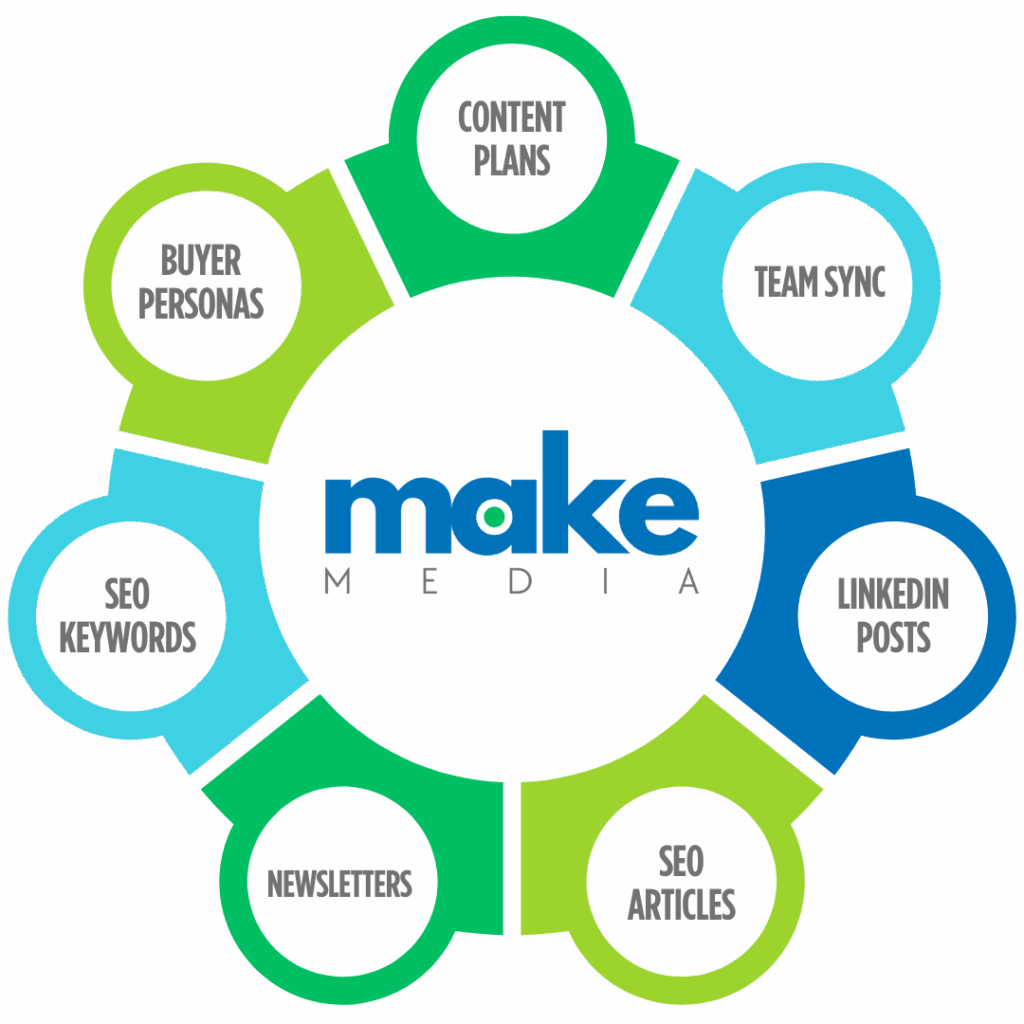
It’s designed for executive and team workflows to work seamlessly, which makes building and maintaining your executive presence faster, cheaper, and far less painful.
We’ve built AI agents for content marketing that first learn about your background and brand voice. Then, we build a content strategy designed to elevate your executive voice to reach your target audience.
You simply answer questions in about 10-minutes through guided interviews that tap your expertise, allowing you to share the knowledge and insights that will build your executive visibility. You can also repurpose past conversations from meeting recordings, webinars, and podcasts by using our “recording-to-content” agents.
Then, click “Create” and it transforms your conversations into high-performing content in your authentic brand voice.
It’s the tool I wish I had when I built my prior companies. Life would have been so much easier.
Book a free consultation to see if it’s a fit →
It will help you scale. And scale is what matters for your business growth.
