

This detailed SEO Best Practices Checklist guides you through actionable steps that will increase your ranking on Google. It covers how to approach keyword research, content creation, and on-page optimization.
Having a checklist for your B2B SEO strategy makes creating content easier. In this SEO best practices checklist, you’ll learn how to match your keywords with the customer journey, create high-quality content that showcases your expertise, and add effective on-page elements.
Is SEO Worth It?

Use our free SEO ROI Calculator to get your custom cost vs. benefit analysis including estimated number of leads, customers, and net new revenue.
These proven tactics will equip you to improve your search engine rankings and attract more targeted visitors to your site. You’ll find valuable insights to enhance your online presence and achieve your business goals. You might also like our other guide: The Anatomy of Stellar B2B SEO Content.
Table of Contents
SEO Best Practices: Keyword Research
To follow SEO best practices, start with customer-centric keyword research. Understand your prospects’ different activities throughout the day that tie into your services and products.
Identifying Your Keyword Strategy
Here are the SEO tactics I’ve found to be exceptional in discovering the ideal keywords:
- Identify the current pain points your prospects have – what words are they using to describe the pain/problems they are trying to solve?
- Use their pain points as a starting point for developing seed keywords
- Analyze the search intent at different stages of the buyer journey
- Look at long-tail terms with three, four, or even five keywords
- If you’re selling a product or service, add words like “service,” “platform,” or “tool” at the end of the main term you’re targeting
Types of Search Intent

Each keyword has a different type of intent:
- Informational intent: Someone looking for information about a particular topic, such as “what is healthcare IT”
- Commercial intent: Someone looking to buy something specific, like “healthcare IT for managing a single-location medical practice”
- Navigational intent: Someone looking for a specific company, like typing in “ABC Company”
- Transactional intent: Similar to commercial intent, someone looking to make a purchase for a particular product, “ABC Company HealthScope pricing”
When creating content, include a mix of commercial intent and informational intent articles, targeting different keywords for each. This results in content that is designed for different stages of the buyer journey. It finds prospects where they are and allows you to build trust as you guide them to a buying decision.
Keyword Mapping Process
The next step is keyword mapping. Align the keywords with your content by following these steps:
- Note your seed keywords
- Create article clusters to develop content for different stages of the customer journey
Buyer Journey Stages
The stages of the customer journey are:

- Awareness: They have a problem they want to solve
- Consideration: They start to think of what they need to solve their problem
- Evaluation: They look at specific products or services that can help them solve their problem
Map your keywords across the buyer journey stages. These SEO best practices will help you gain stronger traction with your search engine optimization efforts. Always keep in mind that a solid SEO best practices checklist starts with keyword research.
High-Quality Content Creation: A Key SEO Tactic
High-quality content is extremely important for getting SEO traction and is one of the most essential aspects of SEO best practices. Google uses a guideline called E-E-A-T, which stands for experience, expertise, authoritativeness, and trustworthiness, to evaluate content and determine whether it is worth ranking.
The Challenge of AI-Generated Content
One of the difficulties Google faces with many AI-only content generators is that they regurgitate AI training data, meaning anyone can produce that content. Throughout 2023, sites started to gain some SEO traction from fully AI-generated content, but at the beginning of 2024, Google introduced a scalable content abuse update to the algorithm.
This update states that if you don’t have the expertise, authoritativeness, and experience to write about such content, Google won’t rank you. As a result, sites that relied on AI-generated content lost their rankings.

AI Content Strategy: Proven B2B Bottom-Up Framework
Use this AI content strategy to get cited in ChatGPT and AI results. Includes framework and step-by-step implementation plan.
Demonstrating Authoritativeness Using MakeMEDIA
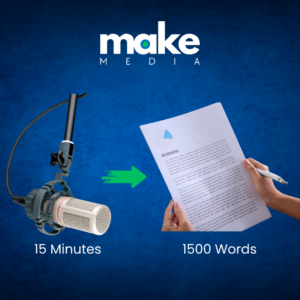
To demonstrate authoritativeness and adhere to SEO best practices, you can use MakeMEDIA to capture your thoughts through a guided interview, sharing unique stories, use cases, and examples that AI training data lacks. One of the most valuable elements is your customer stories. Here’s why:
- You don’t need to share customer names, but you can share examples of how you’ve solved your customers’ problems and tie that back to the keyword.
- This is a strong SEO tactic because it shows Google that you have the experience by including a case study in your article that only you possess.
Creating in-depth articles is another important criterion for achieving high rankings. Although Google maintains that article length is not a ranking factor, longer, more comprehensive content pieces tend to rank higher and faster. During a MakeMEDIA interview, you can discuss your buyer’s pain points, ensuring that your content addresses their needs.
Formatting for Visual Appeal and Readability
To make your content visually appealing and easy to digest, format it using:
- Section headings (H2 tags) that cover the main points and incorporate one of the target keywords for the article
- Subsection headings (H3 tags) to break up long descriptions below the main headings
- Enumerated lists or bullet points to present different points in an easily digestible format
When MakeMEDIA produces the draft from your interview, you’ll automatically receive a well-formatted article that takes the thoughts from your discussion and turns them into a unique, original piece. You can then add your final touches for editing, ensuring that your content follows SEO best practices and showcases your expertise and authoritativeness in your industry.
Incorporate these SEO tactics into your content creation process to improve your chances of ranking higher in search results and attracting more qualified traffic to your website.
On-Page SEO Elements: Essential Best Practices
On-page SEO refers to all the elements that you put on a specific page to help it get ranked. This is different from off-page SEO, which can include link building and other strategies.
Key Points in Your SEO Best Practices Checklist

- Include your keyword in a heading tag as a solid SEO best practice.
- Optimize your keyword placement by using it throughout the document, not just in the heading sections (H1, H2, H3). Aim for 3-5 mentions or more, especially for longer articles. Use variations like plural and singular versions.
- Enhance visual appeal with images and videos. According to a Semrush study, pages with videos have twice the inbound links compared to those without. Even a short video of you discussing the topic can be beneficial. Always include a featured image and place your keyword in the IMG ALT tag for each image. When targeting multiple keywords, use different images for each one.
Internal and External Linking Strategies
Incorporate both internal and external links in your article:
- Include at least one internal link to another page on your website and one external link to an educational or industry-related site.
- Aim for 2-3 external links and 2-4 internal links.
- For internal links, use the keyword you’re targeting for the linked page as the anchor text in your current article.
- Avoid creating multiple articles with the same target keywords to prevent confusing Google.
Converting Visitors into Leads
Add a call to action to convert visitors into leads using one of these methods:
- Slider: An element that slides in from the side or drops down from the top after a certain time or scroll depth.
- Pop-up: Blanks out the whole page with your offer. An exit-intent pop-up appears when a visitor tries to leave.
- Inline form: A contact form with a specific offer related to your content, such as scheduling a demo or getting a free guide. Place it partway down the page for visibility.
These SEO tactics work together incrementally to improve your search engine rankings, much like scoring points in a basketball game. By incorporating these best practices into your on-page optimization and creating a compelling offer, you can attract more qualified leads and grow your business.
Take Action: Elevate Your SEO Strategy
Implementing these SEO best practices can significantly improve your online visibility. MakeMEDIA can manage a large part of your content marketing effort very efficiently, saving you time and money while working with you and your team to produce high quality content fast.
MakeMEDIA was designed to overcome the challenges companies encounter in content marketing and build a customized strategy that aligns with your objectives. Generating articles, blogs, guides, white papers and social media posts doesn’t have to be complicated or time-consuming. Neither does your SEO strategy to help you attract qualified leads.
We’ll help you enhance your search rankings and attract more qualified leads to your website. Take the first step towards achieving your online marketing goals with our expert guidance.
Try it free today:
