
AI content strategy has become a make-or-break factor for B2B brands. Your content team publishes regularly. Blog posts go live every week. Your editorial calendar is full for the next quarter. But when someone asks ChatGPT or Perplexity about solutions in your category, your brand doesn’t appear in the response. Your competitors do.
Most B2B marketing teams build content from the top of the funnel downward. They start with broad awareness topics, move to consideration content, and eventually create decision-stage pieces about their product. This approach worked when buyers clicked through search results and read multiple articles on your website. It fails when AI platforms combine answers from multiple sources and present them in a single response.
Table of Contents
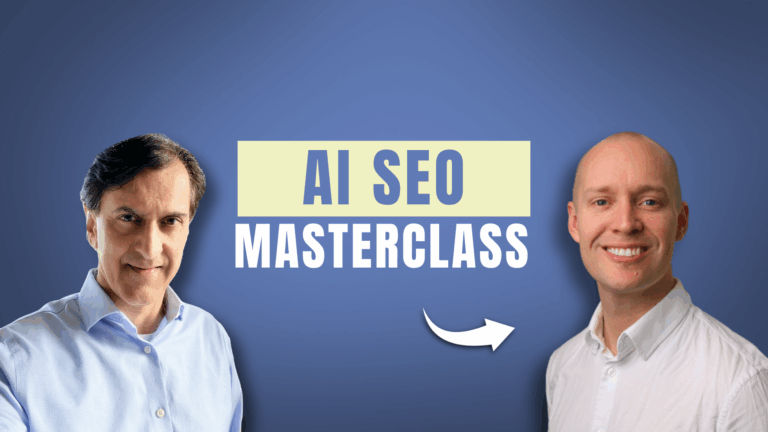
I spoke with Nathan Gotch, CEO of Rankability and a search marketing veteran with over 120,000 YouTube subscribers. He has analyzed hundreds of AI search results across industries to understand what content gets cited. What he found goes against conventional content marketing wisdom: you need to flip your entire approach and build from the bottom up.
In this guide and the accompanying podcast, which is an AI SEO masterclass (below), you’ll learn exactly what to do.
Why Top-Down Content Strategy Fails In AI Search
Traditional content strategy assumes buyers follow a straight line. Someone finds out they have a problem, researches potential solutions, evaluates options, and makes a decision. Your content maps to each stage. Awareness content brings them in. Educational content nurtures them. Product content converts them.
Need content ideas? Here you go:

B2B Go-to-Market Strategy: 78 Content Ideas to Build Clarity
This model assumes buyers read your content in order on your website. AI search works differently. When someone asks ChatGPT “what are the best enterprise project management tools for remote teams,” they get a combined answer pulling from multiple sources. The AI either mentions your brand in the answer or skips you entirely.
AI platforms use retrieval augmented generation to build responses. They query search engines, find relevant sources, pull out information, and combine an answer. Your content must be indexed, specific, and authoritative on the exact query to get cited.
Nathan tested this across different industries. He searched for local services, SaaS products, and e-commerce items across ChatGPT, Perplexity, Claude, and Gemini. The content that got cited most often was specific and detailed:
- Product comparisons
- Detailed reviews
- Knowledge base articles
- Alternative pages
Broad thought leadership rarely appeared. Your AI content strategy should focus on content that gets cited rather than content that generates the most traffic.
The Bottom-Up Content Framework to Get Cited
Building an AI content strategy from the bottom up means starting with the most specific, highest-intent queries and working toward broader topics. You begin with people who already know your brand exists and want specific information about it. Then you expand to people comparing options. Finally, you reach people earlier in their research.
Stage 1: Own Your Brand Queries
Start by listing every question someone might ask specifically about your company, product, or brand. These are bottom-of-funnel queries from people who are already aware you exist. They might ask about:
- Pricing
- Features
- Integrations
- Use cases
- How you compare to competitors
Create detailed knowledge base articles for each query. When someone asks ChatGPT about your product, the AI should pull from your knowledge base to answer accurately. Without this content, the AI will either make something up based on limited information or skip mentioning you entirely.

I saw this approach work at my previous company, MailerMailer, an email marketing software tool. We built a knowledge base primarily to help customers, but it became our highest-performing content for search visibility. One article explained “what is RFC” (Request for Comments, a technical internet standard). Google started ranking it, and we noticed significant traffic for that term.
We doubled down on knowledge base content and watched traffic grow steadily. More importantly, that traffic converted. Companies like Toyota and DuPont called us after finding those articles. The same principle applies to AI content strategy now, except those articles feed AI responses instead of just ranking in Google.
Write each knowledge base article to answer one specific question completely. If someone asks “how does your product integrate with Salesforce,” your article should explain the integration process step by step, include screenshots or diagrams, list any prerequisites, and address common problems. This level of detail signals authority to AI platforms and increases citation likelihood.
Stage 2: Dominate Comparison Queries
After covering brand-specific queries, move to comparison content. These queries come from people who know solutions exist and are evaluating options. They might search:
- “Asana vs Monday”
- “Best alternatives to Jira”
- “Project management tools comparison”
Create dedicated comparison pages for each major competitor. Write fair, balanced comparisons that acknowledge your competitor’s strengths while explaining where your product differs. AI platforms trust content that appears objective more than content that seems purely promotional.
Structure your comparison content with clear sections that address specific decision factors:
- Pricing comparison
- Feature comparison
- Use case comparison
- Ideal customer profile for each product
This structure makes it easy for AI platforms to pull out specific information when answering comparison queries.
Nathan’s team is building a content cluster of 200 articles around AI search tracking tools. They started with a pillar article: “21 Best AI Search Tracking Tools.” From there, they’re creating a detailed review of each tool, an alternatives page for each tool, and comparison pages between each tool and their product.
This approach means that regardless of what specific comparison someone searches, content addresses it.
Stage 3: Build Deep Topic Clusters

After owning brand queries and comparison queries, go deep on topics that matter to your market. This is where your AI content strategy expands to reach people earlier in their buying process who may not know your brand yet.
Most companies create one or two articles per topic and move on. AI platforms need more to view you as authoritative on that topic. You need detailed coverage that shows depth of knowledge.
A content cluster starts with a pillar article on a broad topic, then builds supporting content that covers every angle of that topic. The pillar article provides an overview. Supporting articles go deep on specific aspects.
For a project management software company, a pillar article might be “How to Manage Remote Teams Effectively.” Supporting articles would cover specific challenges:
- “How to Run Effective Remote Standup Meetings”
- “Remote Team Communication Tools Comparison”
- “Time Zone Management for Distributed Teams”
- “Building Remote Team Culture”
Each supporting article links back to the pillar and to related supporting articles. This internal linking structure helps AI platforms understand topical relationships and authority.
Topic Depth For Your AI Content Strategy
Nathan recommends going much deeper than most content teams think reasonable. His current cluster has 200 articles on a single topic. That might sound excessive, but it reflects how people actually search in AI platforms.
Someone doesn’t just ask “how do I manage remote teams.” They ask incredibly specific questions:
- “How do I handle a remote employee who misses deadlines consistently”
- “What’s the best video tool for remote teams with poor internet connections”
- “How do I onboard a remote employee in a different country with different holidays”
Each specific question represents content opportunity. If you have an article addressing that exact question, you can get cited. If you have a broad article that mentions it in passing, you won’t.
CONTENT CREATION TIP

To identify which questions to answer in your AI content strategy and framework, use ChatGPT itself.

→ Ask it "what are the 50 most common questions people ask about [your topic]."

→ Review the list and create content addressing each question.

→ Then ask "what are common problems people face when [specific scenario related to your topic]."

Each problem becomes another content opportunity.
How To Capture Executive Knowledge
Executive expertise often gets overlooked in AI content strategy. Your executives have deep knowledge about your industry, your customers’ problems, and your product’s capabilities. That knowledge is valuable for content creation, but most executives don’t have time to write articles.
The solution is capturing that knowledge efficiently and amplifying it across multiple content formats. Book a full day with your executive. Have someone interview them on camera about everything they know related to their expertise. Record the conversations and build a knowledge database from the transcripts.
MakeMEDIA's AI content strategy agents take you from ideation → interview → first draft.

You simply click Talk to answer questions on relevant topics - anywhere, anytime.

Within minutes, you'll get authentic thought leadership LinkedIn posts, SEO-rich articles, and newsletters in your brand voice.

See How It Works →
That single day of recording (or 5-10 minutes if you use MakeMEDIA) gives you raw material for dozens of content formats:

- LinkedIn posts
- SEO-rich Articles
- Email newsletters
You’re asking them to talk about what they already know, which is much easier and faster than writing.
Nathan built his YouTube channel to over 120,000 subscribers using this principle. He doesn’t script everything perfectly. He outlines topics, then explains them conversationally on camera. That authentic expertise comes through and builds trust faster than polished, scripted content.
Prepare questions before the recording day that cover every aspect of the executive’s expertise. Ask them to explain concepts they think are obvious. Those “obvious” explanations often become the most valuable content because they address gaps in market understanding. Ask them to walk through customer scenarios they’ve seen repeatedly. Those scenarios become case study content and problem-solution articles.
10 Step AI Content Strategy Implementation Plan
Implementing an AI content strategy requires a systematic approach. Follow these steps to build content that gets cited in AI platforms:
- Conduct a content audit – Document every piece of content you currently have. Categorize it by funnel stage (brand-aware, comparison, educational). Identify gaps where you have no coverage.
- List all brand-specific queries – Write down every question someone might ask about your company, product, features, pricing, implementation, and support. Aim for at least 50 questions.
- Create knowledge base articles – Write detailed answers to each brand-specific query. Use clear headings, include examples, and add schema markup. Publish these first.
- Identify your top 10 competitors – List the companies prospects compare you against most often. These become your comparison content targets.
- Build comparison pages – Create a dedicated comparison page for each major competitor. Include fair assessments of strengths and differences.
- Choose your first topic cluster – Select one topic where you want to establish authority. Pick something closely related to your product that your target buyers research.
- Create the pillar article – Write a detailed overview of your chosen topic. This should be 1,500 to 2,500 words covering all major aspects at a high level.
- Build supporting articles – Identify 15 to 20 specific questions within that topic. Create detailed articles answering each question. Link each back to the pillar and to related supporting articles.
- Set up tracking – Run test queries in ChatGPT, Perplexity, Claude, and Gemini weekly. Document which sources get cited. Track when your content starts appearing.
- Review and expand monthly – Every 30 days, assess which content gets cited most. Create more content in formats that perform well. Identify new gaps and add them to your production queue.
Measuring What Matters In AI Search Results
Traditional content metrics focus on traffic and engagement. These metrics matter less when your content gets cited in AI responses where users may never click through to your site.

Your AI content strategy needs different success metrics. Track how often your content gets cited when you run test queries in ChatGPT, Perplexity, Claude, and Gemini. Run the same queries weekly and document which sources appear in responses.
Monitor branded search volume in Google Search Console. Growing branded searches indicate that people are becoming aware of your brand, possibly through AI search citations. Track referring domains using tools like Semrush. As you build detailed content clusters and knowledge bases, other sites will link to your content as a reference.
The most important metric is whether your sales team reports seeing your brand mentioned in prospect conversations. If prospects mention they found you through ChatGPT or ask questions that suggest they’ve already researched you through AI platforms, your AI content strategy is reaching buyers during their research phase.
TRACKING METRICS
- Create a simple tracking spreadsheet.
- Run the same 10 queries across all AI platforms every Monday.
- Document which brands appear in responses and in what position.
- Track your brand’s appearance rate over time.
Moving From Strategy To Execution
An AI content strategy only works with consistent execution. Set realistic production targets based on your team size and resources. If you have a small team, commit to publishing two detailed pieces per week. If you have more resources, aim for five to ten pieces per week. Consistency over time matters most.
You can use MakeMEDIA to accelerate your content production. It includes team workflows.
Quality beats volume. One well-researched, detailed article that thoroughly addresses a specific query delivers more value than three thin articles that barely scratch the surface. AI platforms cite authoritative content, not content farms.
Choose one area to focus on first. Weak brand-query coverage means starting there. Strong brand content but no comparison content means focusing on building competitor comparison pages.
Create a 90-day execution plan with specific deliverables and deadlines. Assign owners to each content piece. Set up tracking to monitor citations in AI platforms. Schedule monthly reviews to assess progress and adjust your AI content strategy based on what works.
Your AI content strategy determines whether your brand appears when buyers research solutions in your category. Companies that adapt their content approach now will dominate AI search results while competitors struggle to understand why they remain invisible.
MakeMEDIA enables you to transform conversations into high-performing content. Try it:
