

Executive personal branding isn’t optional anymore. The numbers tell a stark story. Research from Winning By Design shows that the top 50 public SaaS companies have seen customer acquisition costs rise 60% in the last three years. At the same time, AI has dramatically dropped the cost of building products, flooding markets with new competitors. For executives facing this double squeeze, the old playbook no longer works.
Table of Contents
Santosh Sharan knows this firsthand. As an executive at ZoomInfo, he helped grow inbound leads from 300 per month to over 40,000 per month, taking the company from $10 million to $100 million in annual revenue. He then joined Apollo and helped it reach unicorn status (a $1+ billion valuation) in 18 months. More recently, with a three-person team at RB2B, he signed 50,000 accounts in eight months and hit $5 million in ARR within one year. He is now building ZeerAI.
The secret? A systematic approach to executive personal branding that turns LinkedIn engagement into booked meetings and closed deals. He shares the steps in this podcast and accompanying article.
Personal Branding for Executives
When was the last time you read something from a company’s LinkedIn account? It’s probably infrequently at best. Yet you likely read posts from employees at those companies regularly. This reveals something important about how B2B buying has changed.
Why Company Brands No Longer Win Attention
Company branding teams can no longer carry the weight of differentiation. With AI enabling competitors to copy new features within weeks, product advantages disappear almost as fast as they emerge.
When 30 competitors become 300 because of AI, and all products start looking the same, the challenge moves from building better features to capturing buyer attention.
This means executives must step into a new role. Your junior employees, the SDRs making cold calls to senior buyers, have no stories to share and no credibility to offer. They should not be connecting with C-level executives at target accounts. That mismatch of seniority creates an inefficient process that wastes everyone’s time. Santosh describes this dynamic: telling your six-year-old kid to take decisions when you should be taking them.
The right approach puts executives connecting with other executives. But you can’t do this one-on-one at scale. This is where executive personal branding becomes your growth engine. Instead of relying on company marketing departments, executives who master executive personal branding create direct channels to decision-makers at target accounts.
Not posting much on LinkedIn? Read this: Linkedin Best Practices for Executives
The Weekend Writing Ritual
Every Saturday morning, Santosh sits down with a notepad filled with scribbled observations from the previous week. A customer complaint that revealed a market gap. A conversation with a prospect that exposed a common misconception. A product decision that went sideways before course correction saved the day.

He blocks out two to three hours, usually over the weekend, to transform these raw notes into LinkedIn posts. The notepad stays open on his desk throughout the week, capturing moments as they happen. When a sales call surfaces an objection he has heard five times before, he jots it down. When a competitor makes a puzzling move that actually makes sense once he thinks it through, he writes a quick note.
The system works because Santosh recognized something that’s very simple when you think about it. As an executive, he encounters dozens of business insights every week that hundreds of other people desperately need. A junior employee might handle one type of problem repeatedly. An executive sees patterns across customers, products, markets, and teams. Those patterns become content gold for executive personal branding.
I adopted a similar approach, though mine happens on my morning walks. I’ll be listening to a podcast when an idea comes to mind. I stop, pull out my phone, flip to MakeMEDIA and talk through its interactive interview while I keep walking. It tailors questions to my background, experience, purpose for being on LinkedIn, my content strategy. About 10 minutes later, I have authentic posts and a newsletter ready for review.
This practice requires only one shift in mindset. You keep your radar up during the week, tuned to moments that make you think. You are not writing throughout the week, just collecting raw material. The writing happens in focused blocks when you have time to craft the narrative properly.
Read how to create authentic LinkedIn content with help from AI (key here is authentic):

AI-Powered LinkedIn Content Strategy →
Executive Personal Branding Results
Eighteen months ago, Santosh stared at his LinkedIn profile showing 4,000 followers. He had been an early user of the platform, joining when LinkedIn was still finding its footing. But he had never posted consistently. His profile sat dormant while others in his industry built audiences and influence.
Then the RB2B opportunity arrived. As he and Adam Robinson prepared to launch, they faced a choice. They could spend money on paid ads and traditional marketing. Or they could invest time in building an audience on LinkedIn, connecting directly with potential users, and working in public as they developed the product.
They chose LinkedIn.
Santosh committed to posting regularly, sharing insights from his years at ZoomInfo and Apollo. The growth came steadily. A few hundred followers became a few thousand. A few thousand became tens of thousands. His posts started getting hundreds of likes, then thousands.
But the follower count mattered less than what those followers represented. This was not just an audience for RB2B. This was Santosh’s community. When he eventually moved on to found ZeerAI, that community came with him. The trust he had built, the credibility he had established, the relationships he had formed, all of it traveled to his next venture.
This portability changes the value you can get from executive personal branding.
You are not simply building an asset for your current company.

You are building an asset for your career.
Sales reps are starting to recognize this too. The best ones now cultivate their own communities. When they switch companies, they bring those relationships with them, introducing their network to new products and new solutions.
This represents one of the most powerful advantages of executive personal branding over traditional marketing investments. Company-owned assets stay with the company. Your personal brand follows you everywhere.
How to Convert LinkedIn Engagement Into Meetings Automatically
Not every post needs to sell. In fact, most posts should not try to sell at all. Santosh follows a three-to-one ratio. Three out of every four posts exist only to grow his community or provide value to his audience. These posts offer genuine help around his ideal customer profile and content themes. No ask, no pitch, just value.
One out of every four posts serves a different purpose. This is when he makes an ask. But even then, the approach stays subtle and systematic.
Checklist and Strategy for Executive Visibility →
Here is how the system works:
When Santosh posts that one-in-four piece of content, he carefully crafts it for a specific ideal customer profile. An automation runs in the background using APIs from tools like Phantom Buster or Expandi. Anyone who likes or engages with the content gets scrubbed against his ICP criteria. The system checks their title and company. If they match the profile, typically VP-level or above, the automation drops a LinkedIn message.
The message stays intentionally vague and generic. Something like: “Hey, I’m building something. Do you want to check it out?” with a calendar link. The same message goes to everyone who qualifies. No customization, no lengthy explanation.
The results speak for themselves:
| Metric | Result |
| Conversion rate on calendar link sends | 50%+ |
| Meetings booked per conversion-focused post | 50-100 |
| Calendar booking window | Next 4 weeks fill completely |
| Optimal outreach timing after post | 2-6 hours |
These numbers reveal why executive personal branding delivers better ROI than traditional outbound methods. The people booking these meetings have already received value from your content. They feel indebted and want to connect. This changes the entire dynamic of the conversation.
The system works so well that Santosh eventually has to turn it off. After running the automation for a day, he looks at his calendar and sees the next four weeks completely booked. Fifty meetings, seventy meetings, sometimes a hundred meetings stack up in his schedule. He pulls the calendar link and stops the automation because he physically can’t take more calls.
The Micro-Celebrity 6-Hour Window for Response
Timing makes this strategy work. When you post content, you create what Santosh calls a “halo effect” for the next 12 hours. You become a micro-celebrity because you just provided value to your network. This creates a brief window for an ask.
But that window closes fast. Santosh has tested this extensively, running the same engagement play at different time intervals. If he waits 24 or 48 hours after posting to send outreach messages, he gets almost no response. People have already moved on. They don’t remember who he is. The micro-celebrity effect vanishes.
The magic happens in the first two to six hours. Reach out while people still remember being impressed by your content. Even better, understand that people may not read your message for a few more hours after you send it, so the sooner you can automate that outreach after they engage, the better your results.
This mirrors findings from Salesloft’s research years ago about demo requests. When companies respond within minutes to inbound interest, they see conversion rates 21 times higher than when they wait even an hour. The same principle applies to LinkedIn engagement and executive personal branding efforts.
Santosh puts it simply: “If they were impressed with your content and they are senior folks, try to get them within the next six hours.”
Why Vanity Metrics Miss the Real Story
Here is where executive personal branding strategy gets counterintuitive. The posts that get the most likes often drive the least revenue. The posts with minimal engagement frequently generate the most valuable meetings.

Santosh sees this pattern consistently. So do I, as do many others I’ve spoken about this phenomena. One of Santhosh’s posts might get 1,000 likes but produce few quality conversations. Another post gets only 50 likes but books 10 meetings with qualified prospects. This seems backwards until you understand the thought process of the audience.
If you write content that appeals to a broad audience, you will get lots of likes. But if your meetings typically happen with decision-makers and executives, those people represent a much smaller group. Content that resonates with VP-level and above buyers will not generate mass appeal. You can’t chase broad themes and expect to attract senior buyers in large numbers.
This means you should not chase likes at all.
"Likes" serve as a vanity metric that makes you feel good but doesn't correlate with business growth.
The real test is whether qualified prospects book time with you. When measuring executive personal branding success, focus on pipeline generated rather than engagement metrics.
In fact, attribution on social media remains difficult by nature. Just yesterday, I sat across from someone at lunch who had reached out after seeing a post I wrote a month earlier. We talked about his business challenges and how our solution might help. The meeting felt warm, like we already knew each other. Later, I checked his engagement on that post. No like. No comment. No share. Yet the post had registered with him strongly enough that he scheduled lunch. The impact of your LinkedIn presence extends far beyond visible engagement metrics.
Edutainment: Crafting Hooks That Stop the Scroll
If you want people to stop scrolling and pay attention, your hook determines everything. The first line of your post carries all the weight. Make it entertaining, not just educational.
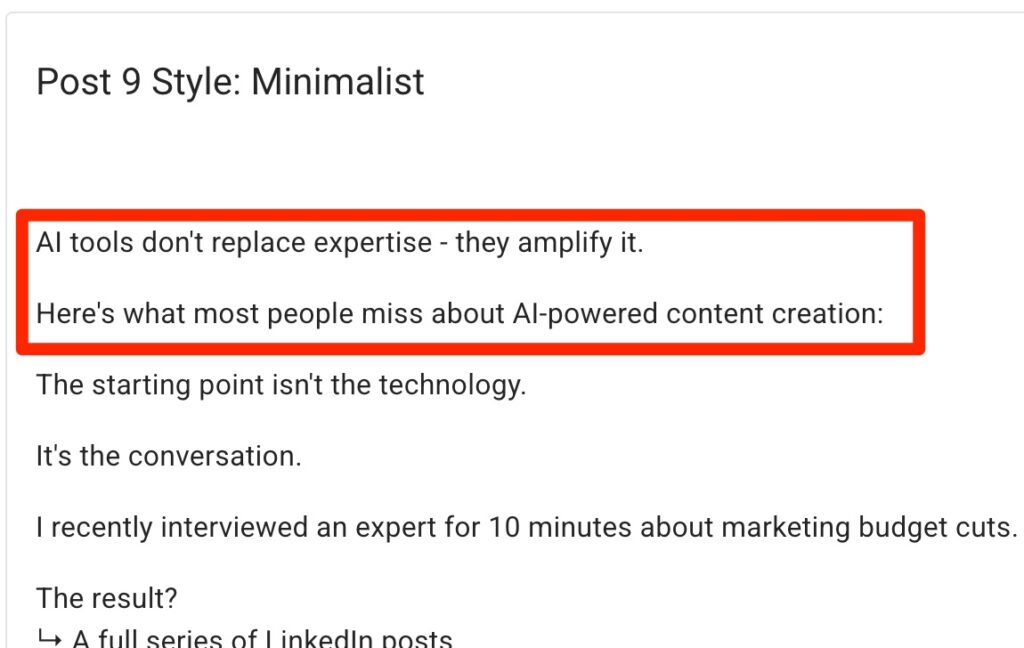
Santosh focuses on what he calls investigative research content and thought leadership. His co-founder at RB2B, Adam Robinson, takes a different approach with more storytelling and emotional charge. Adam shares vulnerability and even does some controversial posting. Both styles work because both are authentic to who these executives actually are.
This authenticity matters more than any tactical advice about what type of content performs best. I have noticed some executives who are not particularly articulate in person suddenly sound like poets on LinkedIn. You can see right through it. They have outsourced their voice to ChatGPT, tossing a quick idea into a prompt and copying the polished output.
Over-reliance on AI writing tools backfires. People scroll through hundreds of posts per session. They spend only seconds deciding whether to read or keep moving. In that brief moment, they can detect when something feels genuine versus manufactured. Authenticity separates effective executive personal branding from content that gets ignored.
This doesn’t mean you can’t clean up your writing or fix grammar. Just make sure the idea itself, the genesis and narrative, comes from you. Let someone else (or a well-built tool like MakeMEDIA) polish the language, but own the thought.
MakeMEDIA interviews you for your expertise, then gives you a draft ready for final edits before publishing. Your authenticity is the core of the tool.
The Valuable Posts That Nobody Wanted to Read
Santosh loves artificial intelligence. With his engineering background, he can dive deep into technical discussions about machine learning models, training data, and algorithmic improvements. He reads research papers. He experiments with new tools. He thinks constantly about how AI will reshape the future of work.
So when he sits down to write, topics about AI feel natural. He crafts detailed posts explaining technical concepts, sharing predictions about AI’s trajectory, analyzing new developments in the field. He hits publish feeling confident these posts will resonate.

Then he watches the engagement numbers. His typical post gets around 400 likes yet his posts about AI get 20.
The drop stings every time. He knows the content is good. He knows the insights are valuable. But his community formed around go-to-market strategy, sales tactics, and marketing execution. They follow him for revenue operations advice, not technical AI analysis. When he shifts to AI topics, they keep scrolling.
Santosh learned an important lesson from this pattern. Your success creates a self-fulfilling cycle. Content that works keeps working better. Your audience expects certain themes and rewards you with engagement when you deliver those themes. Fighting this dynamic feels frustrating. You want to share other interests, explore different topics, bring new perspectives to your audience.
But executive personal branding works best when you lean into what your community values. They followed you for specific reasons. They stay for specific value. If you suddenly pivot to different topics, even topics you love, you break the pattern that made them follow you in the first place.
If you are getting zero engagement despite being an executive with stories to share, your audience likely doesn’t align with your content. Once you fix that alignment, engagement follows naturally. Santosh emphasizes this point: “Success is a byproduct of being who you truly are. All of us perform best when we are in our own zone, when we are comfortable with the identity.”
Using Your Community for Product Validation
The revenue applications are obvious. Book meetings, close deals, grow your business. But Santosh uses his community for another high-value purpose: product validation and market research. This demonstrates how executive personal branding serves multiple business objectives beyond direct sales.
At ZeerAI, he writes posts about general topics related to the products he is building. When people engage, he scrubs their titles to identify who qualifies as relevant for feedback. For one research project, he wanted input from sellers. For another, he needed buyer perspectives.
Through two or three strategic posts, he spoke with 150 sellers and 150 buyers. This gave him invaluable data to validate product assumptions before investing heavily in development. The speed and quality of this feedback loop gives a significant advantage over traditional market research methods.
This ratio keeps your community healthy. If every post tries to sell or extract value, people tune out. But when you consistently give value three times for every ask, people stay engaged and receptive. As Santosh notes: “Three out of four contents that I publish is only for growing my community or engaging with my community. One out of four, I do want to have an ask.”
The Business Case for Executive Investment
Executive personal branding is not optional anymore. You can’t delegate this to your marketing team or your SDRs. They lack the experience, the stories, and the credibility that you carry as a leader.
The market has shifted. Junior employees cold calling senior buyers made little sense even in the old model. Now, with direct channels between decision-makers, that outdated approach looks even more inefficient. Smart executives recognize that investing time in executive personal branding generates higher returns than most traditional marketing activities.
You may feel you don’t have time for this. But think about what else drives more value for your go-to-market strategy. With CAC rising 60% and competitors entering your space in droves thanks to AI, can you afford not to invest a few hours each week in the most efficient channel for reaching qualified buyers?
Goldman Sachs projects that the creator economy will become a half-trillion-dollar business in just the next couple of years. That scale reflects how much the market values quality content and authentic voices. B2B executives who ignore this shift will find themselves drowned out by the hundreds of competitors that AI enables to enter their market.
The financial case becomes clear when you compare costs. Traditional outbound marketing, paid advertising, and event sponsorships require substantial budgets with uncertain returns. Executive personal branding requires time investment but generates compounding returns as your audience grows.
5 Steps to Launch Your Personal Brand Strategy
The community you build through executive personal branding becomes an asset that travels with you throughout your career. Unlike customer lists that belong to your company, your LinkedIn network belongs to you. The trust and credibility you establish, the reputation you build, these follow you to your next role and your next venture.
Santosh built his audience from 4,000 followers to over 40,000 in 18 months through consistent, authentic content. He has used that community to drive growth at multiple companies, validate product ideas, and establish himself as a thought leader in go-to-market strategy.
You can do the same by following these steps:
- Start story banking this week. Keep a notepad open throughout your workday. When you encounter an interesting business problem or discover a useful solution, write it down. Capture customer objections, team debates, product decisions, and market observations. These notes become your content raw material.
- Block weekend writing time. Schedule two to three hours on Saturday or Sunday to review your notes and turn them into posts. Treat this time as sacred. You are building a career asset that compounds over time.
- Follow the three-to-one content ratio. Post three pieces of pure value content for every one post that includes an ask. This keeps your community engaged and receptive when you do make requests.
- Set up engagement automation. Use tools like Phantom Buster or Expandi to automatically message people who engage with your conversion posts. Scrub engagers against your ICP criteria and send calendar links only to qualified prospects. Act within two to six hours while the halo effect lasts.
- Track business outcomes, not vanity metrics. Measure success by meeting bookings and real conversations, not likes or comments. A post with 50 likes that books 10 qualified meetings beats a post with 1,000 likes that generates zero pipeline.
Pay attention to which posts resonate, but measure success by business outcomes. Test and refine your approach based on what generates qualified conversations. This feedback loop helps you improve your executive personal branding strategy over time.
Most importantly, be yourself. Don’t try to copy what works for someone else. Don’t outsource your voice to AI tools. Express genuinely who you are, and let that authenticity become your differentiator in a market where products increasingly look the same.
The executives winning in this new environment are not hiding behind superior products or massive marketing budgets. They are showing up as real people, sharing real insights, and building real relationships at scale through strategic executive personal branding.
MakeMEDIA can help you do all of this for executive personal branding in one interactive conversation.
P.S. Got a podcast? Use MakeMEDIA to repurpose your recordings into authentic SEO-rich articles.
