

A B2B customer journey map helps you understand how prospects find you, what questions they ask, and what moves them toward buying. This process isn’t just about making fancy charts – it’s about building a system that helps you meet customers where they are with the right message at the right time.
This article is part of a series on knowing your customer.
Read our related guide on building your B2B Go-To-Market Strategy.
Table of Contents
Why a B2B Customer Journey Map Matters
When was the last time you bought something from a company that made the process painful? Think about how many times you’ve abandoned a purchase because the buying process was too complex.
Your B2B customers feel the same way. The way your customers buy has changed dramatically. They no longer follow the path you want them to – they create their own routes to purchase. Smart companies recognize this shift and adapt by creating customer journey maps that match how buyers actually behave.
The Customer Controls the Journey – Not You
One of the biggest mistakes companies make is designing a B2B customer journey map based on their own needs rather than their customers’ preferences. Richard Brasser, partner at Carlton Richards and former Boston Consulting Group partner, explains: “Years ago, companies got to decide how you purchase their products. That is totally not the case anymore. The customer is in charge, even in B2B.”
This reality means you must create journey maps based on what customers need, when they’ll engage with you, and how you can help them – not what’s convenient for your sales team.
Take this story from Richard about how not to design a customer journey: “I needed to add my 16-year-old son to our insurance. As a 16-year-old male, it doubled the cost of my insurance. Talk about a sale where you have the lowest cost of sales possible – I’m calling you telling you I want to spend twice as much money. That should be seamless.”
Instead, Richard faced an automated phone system with irrelevant options, couldn’t reach a human, got disconnected multiple times, and struggled to give the company more money. This happens because companies design processes around their internal departments rather than customer needs. B2B customer journey mapping needs to focus on the customer’s actual experience.
What Kind of Content Is Working Today:

B2B Content Marketing Trends Guide for Prioritizing CMO Budgets
Experience Your Own Buyer Journey
One of the most powerful yet often overlooked aspects of B2B customer journey mapping is experiencing your own buying process firsthand. This practice can reveal surprising insights about how your business actually appears to potential customers.
Follow this simple but powerful tip: pretend you’re a customer and try to buy from your business. At minimum, each quarter (or better yet, monthly):
- Call your main business line as if you were a prospect
- Complete a form on your website
- Follow your email nurture sequence
- Test how quickly and effectively your team responds
The gap between how you think your process works and how it actually works might surprise you. This exercise helps identify barriers that prevent potential customers from completing their journey with you.
Tailoring Messages to Different Buyer Personas
When planning your B2B customer journey mapping, remember that “which customer?” is a key question. Different customers follow different paths based on:
- Product type (SaaS vs. on-premises)
- Geographic region
- Company size
- Industry
Beyond these segments, consider the different roles involved in B2B buying decisions. Richard explains how each person cares about different things:
- Economic buyers care about productivity gains and increased sales
- CFOs focus on forecast reliability and accuracy
- Operations people want daily headaches to be eliminated
“We used to have a different approach depending on who was on the call to touch on different value they would get out of it,” Richard notes. “Think about who’s in the buyer’s journey. It’s not just the buyer, like company XYZ. It’s humans that have roles.”
The worst mistake? Assuming everyone has the same decision criteria as you.
Create accurate buyer personas fast using MakeMEDIA's AI Persona Generator
Creating Content That Actually Helps
Many companies claim to offer educational content but actually just provide sales materials. During my conversation with a large antivirus company about doing a webinar, they said, “We’ve got lots of very educational content.” But it was all sales material.
This approach only works for prospects who are already close to buying. Most people aren’t at that stage yet. Your B2B customer journey map needs content that pulls people into your orbit when they’re simply looking for answers.
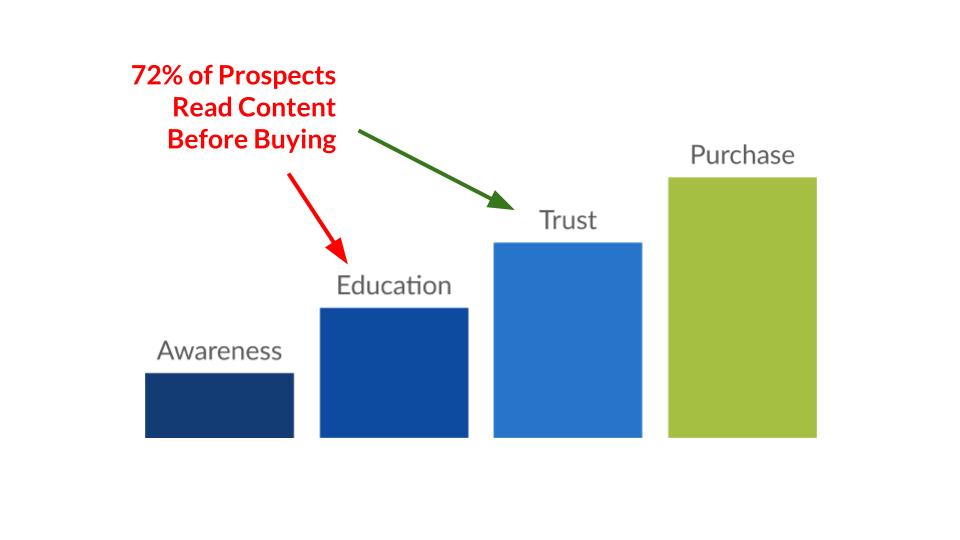
Richard describes becoming a fan of a thought leader: “I saw a few of his posts on LinkedIn. I thought they were smart and well done. He provided plenty of opportunities in his posts – I have a blog, a video podcast, stuff online, a website. I decided to look at his blog. His topics were quite interesting. His website was engaging and informative. I was getting value out of all of that.”
The thought leader didn’t know he had a potential fan, but his content strategy was working perfectly. Richard was doing all the work himself, following a trail of valuable content.
Multimodal Engagement Strategies
Ten years ago, people found vendors through limited channels: referrals, advisors, analyst reports, Google, events, and sales calls. Now, the options have multiplied. People research in many different places and often don’t want to talk to sales reps even for high-ticket items.
For B2B companies, these channels seem to work particularly well:
- YouTube
- Podcasts
Other places worth watching include Reddit and Discord, where professionals discuss their challenges. Your B2B customer journey mapping must account for these new research habits.
The key is being where your customers are having discussions. As Richard notes, “Your goal is to be there as a facilitator and as a service and as a value provider, not as a manipulator.”
Nurturing Leads Through Each Stage
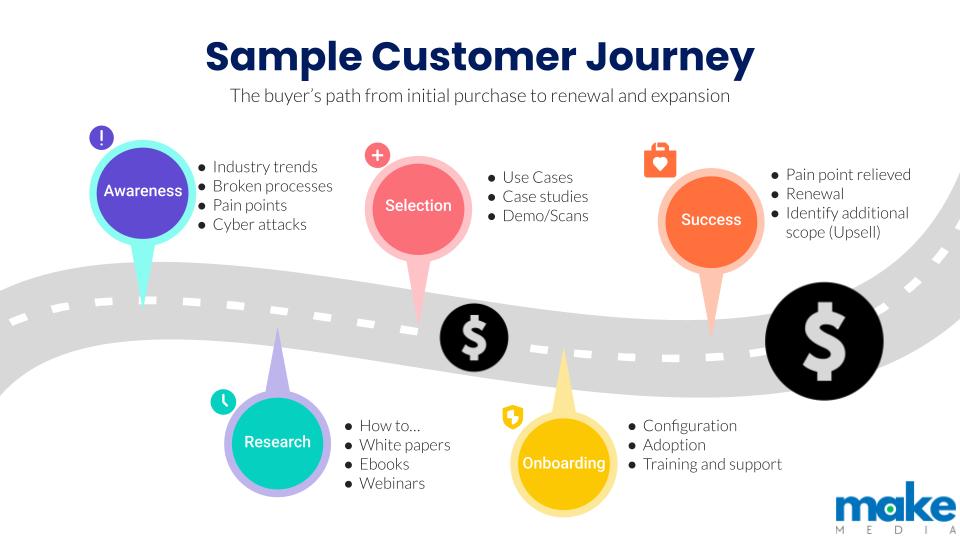
Your B2B customer journey map should include clear strategies for what content to provide at each of the pre-sales customer journey stages:

- Awareness stage: Educational content that helps solve problems and establishes thought leadership
- Consideration stage: Case studies, use cases, and more specific solution information
- Decision stage: Detailed product information, pricing, and implementation details
Lead scoring plays an important role in this process. Richard explains that modern technology allows for much more sophisticated lead scoring than traditional firmographic data: “If two companies look alike in firmographics, they are not always alike in how they act, how they buy, what they want, how they make decisions.”
Richard’s team even identified “disqualifiers” that indicated problematic deals: “In our old business, if a CTO or head of IT got involved, that deal is going to get slowed down by two or three times. So we de-prioritized it.”
Smart lead scoring can improve conversion rates by 20-30% just by helping you focus on the right opportunities first.
The Purchase Is Just the Beginning
Many sales teams treat closing a deal as the finish line. This mindset is a major mistake. As Richard points out, “It’s not the finish line, it’s the beginning of your relationship with a client.”
Richard’s team created a process called “Success After Yes” that started before closing but outlined everything that would happen after the client signed: who would be involved, training schedules, implementation steps, and more.
This approach accomplished two things:
- It removed fear about what happens after purchase
- It set up customer success teams for effective account management
The process focused on key metrics like account expansion, retention, and lifetime customer value. Without this part of your B2B customer journey map, you risk customers feeling abandoned after signing.
I often see companies make huge promises during the sales process but deliver terrible onboarding experiences. This disconnect damages trust and limits growth opportunities.
Using AI in B2B Customer Journey Mapping
AI has changed how we approach B2B customer journey mapping, but many companies misunderstand its applications. Richard cautions against thinking ChatGPT represents all of AI: “That is a large language model. It’s something you can ask a question to, and it’ll give an answer based on the ingestion of the internet. That is just one tiny part of AI.”
More valuable AI applications for customer journey optimization include:
- Finding patterns in customer data to identify your true ideal customer profile
- Discovering new market segments that match your best customers
- Creating heat maps that show which products, regions, and segments are most profitable
- Using guided selling tools that predict closing odds and recommend actions
- Identifying expansion opportunities with existing customers
Richard warns that many companies claim to use AI but don’t actually do so: “There are companies that have launched a new forecasting tool that’s ‘AI.’ It’s not AI. But only the people that know AI can tell you that.”
For content creation, be careful about relying too heavily on AI. As Richard notes, “The process that AI does is it collects everything, and then it delivers the most common answer. The most common answer is not going to differentiate you and make you sound amazing.”
This matches my experience with SEO. Clients who simply use ChatGPT to generate content about topics like cybersecurity protection get the same content as everyone else. Google has started penalizing this generic AI content because it adds no value.
Taking Action on Your B2B Customer Journey Map
B2B customer journey mapping isn’t a one-time project – it’s an ongoing process of understanding how your customers buy and adapting to meet their needs. Here are key actions to take:
- Test your own buying process regularly to find and fix friction points
- Create content that educates rather than just sells
- Meet customers where they are through multiple channels
- Design for different buyer roles with messaging that addresses their specific concerns
- Build a “Success After Yes” process that guides customers after purchase
- Use AI and technology thoughtfully to enhance the journey, not just as buzzwords
Remember that the most successful B2B companies don’t try to force customers down a predetermined path. Instead, they create journey maps that match how buyers actually make decisions, providing value at every step along the way.
By mapping your B2B customer journey accurately and aligning your marketing and sales efforts to customer needs, you’ll not only close more deals but also build stronger relationships that lead to expansion opportunities and higher lifetime value.
MakeMEDIA Creates Your Customer Journey Content Plan
Guiding your prospects through your customer journey map requires you to have the right content to use at the right time. MakeMEDIA’s content planner builds a complete content plan mapped to each stage of your buyer’s journey.

It addresses the questions that prospects have as they flow through their path to make a purchasing decision. More so, it focuses on every buyer persona you have so there are no gaps in your content plan. You can create your plan today within minutes of trying MakeMEDIA:
