

B2B SEO content optimization requires more than inserting keywords into technical articles. It demands a framework that bridges the gap between subject matter expertise and search visibility. This article shows you how to build a repeatable workflow that preserves technical accuracy while meeting the structural requirements search engines demand, explains why vertical-specific content outperforms generic articles, and reveals how to map keywords to buyer personas and journey stages.
You’ll learn the specific elements that impact ranking, from cross-linking strategies to terminology choices, and see how to balance technical depth with optimization requirements that help both traditional search engines and AI platforms find your content. If you’re struggling to get your technical content found online or wondering why your expertise isn’t translating into search traffic, this framework provides the actionable steps you need to close that gap.
Table of Contents
The B2B SEO Content Optimization Framework for Technical Subject Matter
Technical writers excel at explaining how things work. They strive to develop a clear understanding of a product’s functionality. However, they have not usually been trained on how potential customers search for solutions online. This is where a content gap can occur if you hire an outside firm to handle your writing, or sometimes even when internal team members produce the technical writing.
These writers fully understand the subject matter, and they might even understand the customer base quite well. But the understanding of how people conduct searches online represents a real gap.
This mismatch between what you need to publish for technical topics and content that reads more like a technical white paper creates a problem. People may not find you without the search engine optimization components your content requires.
More Details: AI SEO Best Practices
B2B SEO Content Optimization Goes Beyond Keywords
A lot of people assume that effective B2B SEO content optimization simply means inserting a bunch of keywords into the content. It actually goes far beyond that. A large part of this effort centers on structure, and page structure directly impacts your ability to get found in search results.
If you don’t embed keywords in the right parts of your content, you reduce your chances of ranking. Here are the specific elements that matter:
- Section headings
- Page title
- File name
- Image alt tags
- Image file names
- Keyword density, meaning the number of times a keyword and its semantically or thematically related variations appear throughout the content
All of these elements play a role in whether your audience discovers your content.
The Other Side of the Technical SEO Gap
Hiring someone who specializes strictly in search creates a different kind of gap. That person may not fully understand your audience or the technical depth your audience expects. They may not grasp how your audience consumes content, and they typically don’t understand the technical rigor your content demands.
Finding a balance between technical accuracy and search visibility is the key here. You need both sides working together, not one at the expense of the other.
Building a Repeatable, Optimized Workflow
You should create a repeatable, optimized workflow to address this challenge. Before anybody writes a word, document the technical requirements for your article and the keywords you want to include as part of your seo keyword planning process. Then set up an interview process where a technical writer interviews the subject matter expert.
You can also use MakeMEDIA for this. It makes it very simple for subject matter experts and technical experts to create content simply by answering interview questions.
Solving the “What Do I Ask?” Problem
Another component that MakeMEDIA offers addresses a common problem. If your interviewer — whether a marketing agency or an agency interviewing its clients for content — may not know exactly what to ask, that again ties back to the gap mentioned earlier.
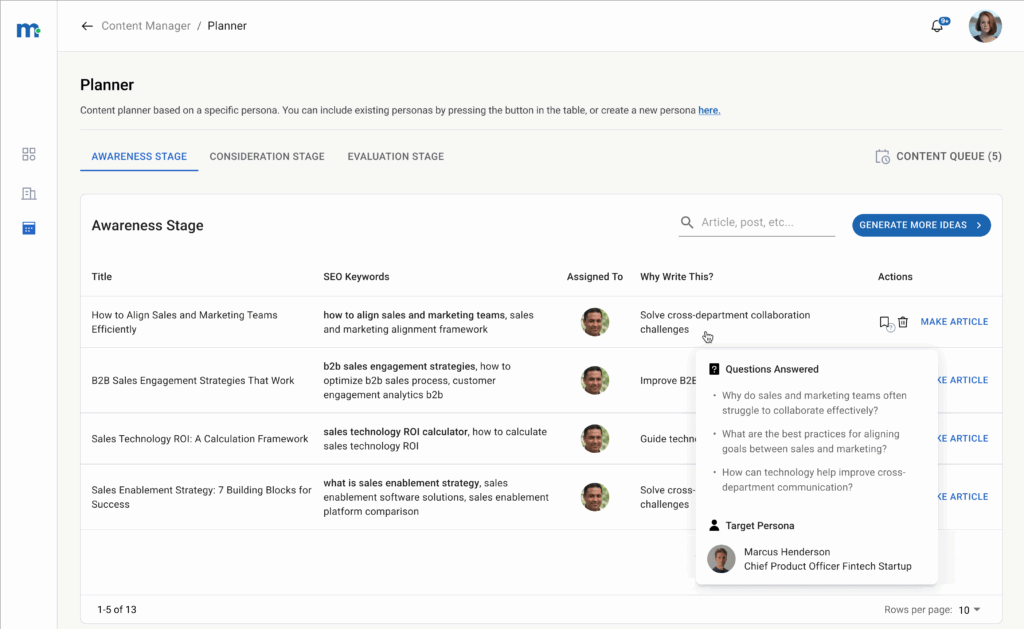
MakeMEDIA includes a tool that allows you to quickly create an interview that also identifies which keywords you need to use, along with several other components that produce a very high-quality, technically sound article.
From Interview to Optimized Article
Once you interview your subject matter expert, check that interview for technical accuracy, then transcribe it. From the transcription, you can start building your article out.
Inside the article, make sure you fully optimize it using traditional technical SEO for B2B methods. This serves as both the starting point and the launching point for getting ranked inside AI-generated results as well.
As you write, consider adding structural elements that make it easier for AI to grasp the key concepts inside your content. Ideal B2B SEO content optimization for AI includes these elements of page design:
- Questions and answers such as FAQs
- Bulleted lists
- Tables
- Use cases and case studies
- Examples featuring real clients
- Metrics that can’t be found elsewhere
AI-generated answers particularly favor unique metrics and data-rich content. All kinds of search responses reward this type of information, and these additions collectively raise the quality of what you publish.
How MakeMEDIA Streamlines the Entire Process
MakeMEDIA actually handles all of the B2B SEO content optimization for you. It conducts the technical interview with appropriate questions, then listens and converts the transcript into a first draft of an SEO-rich article. That makes the entire process significantly easier.

Your experts see that you’ve retained their key thoughts in the content. At the same time, you avoid losing or dumbing down any of the technical substance, and you maintain the structure that SEO demands.
Technical SEO for B2B: Architecture Decisions That Impact Enterprise Content Performance
A strong technical SEO for B2B strategy goes beyond basic on-page optimization. It requires thoughtful architecture decisions that connect your content together cohesively and send the right signals to both traditional search engines and AI-powered search platforms. Google search still generates roughly 200 times more traffic than AI search, but building a solid technical foundation now positions your content to rank well across both channels.
Cross-Linking as a Foundation for Content Architecture
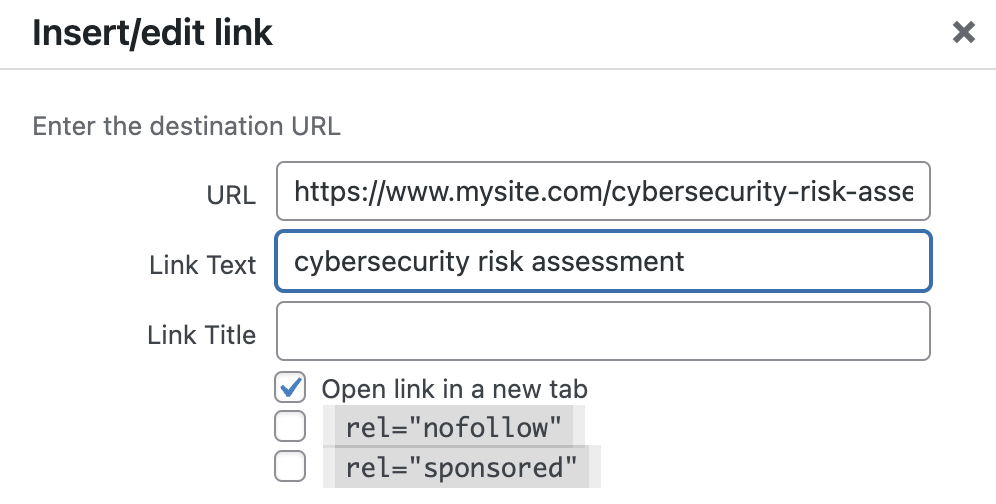
There’s a good chance you already have published articles that relate to the new content you’re creating. One of the most effective components of B2B SEO content optimization is cross-linking between related pieces. You should find a relevant keyword within your new article and use it as anchor text to link to an existing, related piece of content.
Imagine you have an existing article titled “Common Cybersecurity Mistakes That Accounting Companies Make.” If you’re now writing an article on how to assess your cybersecurity risk or exposure, you could include a link from that new article out to the accounting-focused piece. This is straightforward because you’re simply connecting content that already exists on your site.
Updating Older Articles With Links to New Content
There’s another component that makes an even bigger impact: going back to previously published articles and updating them with links that point to your new content. If you’ve created a series on cybersecurity for different professional service firms, you would go to each of those existing articles and add a link back to the article you’re currently working on.
This instantly creates signals to search engines that point to the new article, and it increases the chances of that content getting ranked significantly faster. Think of it as building a web of internal connections that reinforces the relevance of every piece you publish.
Vertical-Specific Content Over Generic Content
Rather than writing a generic article like “Cybersecurity Mistakes That Professional Service Firms Make,” you should create a specific version for each type of service firm you provide solutions for. That means separate articles for audiences such as:
- Attorneys and law firms
- HR firms
- Public relations firms
- Advertising agencies
- Marketing agencies
- Accounting firms
Yes, this means producing a large volume of content. But something interesting happens as a result, particularly with AI search: people provide context in their queries. Someone might type, “I’m an accounting firm. What are the things I need to watch out for in terms of cybersecurity?”
An article written specifically for accounting firms, complete with accounting firm use cases, case studies, and terminology, has a much higher chance of ranking than a generic professional services article. This tactic is a hidden gem for B2B SEO content optimization and can increase your visibility quickly.
Why Terminology Matters More Than You Think
The language your target audience uses should factor directly into your seo keyword planning process. Terminology differences may seem like a small nuance, but they make a massive impact on the searchability of your content because people search using the words they’re familiar with.
Think about how different verticals refer to the people they serve:
- Healthcare professionals call them patients
- Nonprofits call them donors or patrons
- B2B companies call them clients
- B2C companies call them customers
Tailoring your content to each vertical with the right language is one of the biggest advantages of creating firm-specific articles. You’re not just swapping out a word here and there. You’re matching the mental model your reader already has, which makes your content feel more relevant to both the reader and the search engine.
Keyword Frequency and Structural Readability

The frequency with which your target keyword appears throughout your article also matters. You want that keyword to show up naturally across the different sections of your content.
But frequency alone isn’t enough for true B2B SEO content optimization. The ease with which your article can be read plays a major role in performance. Content that consists of nothing but dense paragraphs is difficult to read and nearly impossible to skim.
You must break your content into clear section headings and place your primary keywords along with semantically related keywords in those headings. Here are the structural basics to follow:
- Use the H2 tag for main section headings
- Use the H3 tag for subheadings
- Place the keyword in your title
- Place the keyword in the file name
These structural choices send stronger signals about what your article covers because keywords inside headings carry more weight than keywords buried in body text.
The Role of Images in Content Indexability
Images make a significant impact on how your content performs. If you’re writing a technical document, you have plenty of options to enhance the visual experience. Think about including diagrams, flowcharts, pictures of people using your product, or screenshots.
These visual elements enhance your article’s indexability by creating visual appeal and making the content easier to consume. Google and other platforms reward articles that offer a better reading experience. AI search engines may not value images as highly, but you don’t need to create one set of content for AI and another for Google. Including images optimizes your content for both channels simultaneously.
The SEO Keyword Planning Process for Enterprise Buyer Journeys
Your seo keyword planning process should ensure that every keyword addresses the specific personas you are targeting. MakeMEDIA allows you to create an unlimited number of detailed personas, complete with information about each persona’s pain points, challenges, messaging preferences, and information consumption habits. The platform takes all of that into account as it creates a first draft for you.
Mapping Keywords to Personas

Think about it this way — you may be writing an article about cybersecurity, but a CFO will want to hear different things about that topic than a CTO would. The CFO cares about return on investment and whether the solution will improve productivity. A CTO, on the other hand, approaches it from a completely different point of view, looking for SOC 2 compliance or other technical measures.
A COO or manager might focus on how their teams can become more effective. And the end user will want something entirely different — how to actually use the product, whether it will save time, and whether it will help them get their job done. These are completely different personas that would want insights on the same topic, and that gives you another angle where you could write content for each persona separately.
Understanding Keyword Intent Signals
Keywords often signal intent distinctions that matter for B2B SEO content optimization. Here’s an example to illustrate the point: let’s say you had a solution and wanted to create a how-to article about the considerations you must take into account to assess your cybersecurity risk. That is an informational intent piece of content, and the reader is not necessarily going to buy from it.
Now picture a different article: a cybersecurity risk assessment threat assessment action plan. That is something somebody wants to actually take action on. The intent behind a keyword like “action plan” or “checklist” differs significantly from someone searching for “best practices,” which skews more informational. Commercial intent versus informational intent makes a real difference in terms of who you attract.
Aligning Content with the Buyer Journey
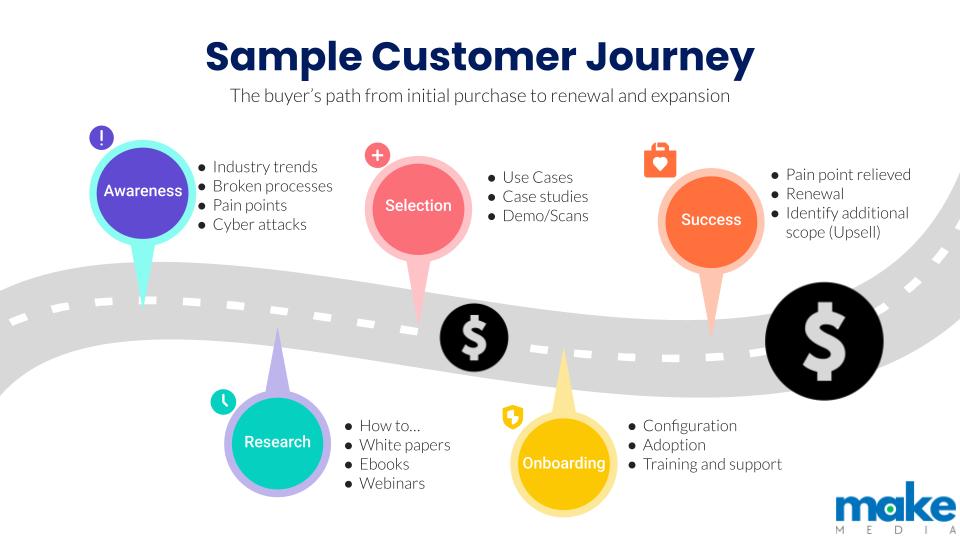
This distinction also plays a role not just in targeting the right buyer persona but in mapping content to the buyer journey itself. Three pre-sales stages typically exist:
- Awareness stage — the prospect recognizes they have a problem
- Consideration stage — the prospect researches possible solutions
- Evaluation or decision stage — the prospect is ready to choose a solution
You will need different pieces of content for each of these stages.
If you haven’t built much content on your website yet, I would recommend starting with the decision stage of the buyer journey because that will usually attract people toward the bottom of the funnel and help you increase your sales faster.
That said, this does not mean you only create bottom-of-the-funnel content. You still need consideration stage content because if you are only creating content for the 5% of people who might be ready to buy your product right now, you are missing 95% of the market that you can nurture and send brand signals to.
As those prospects become sales ready, they start to think of you first. That is a massive advantage you will have over your competitors, especially when you deploy technical SEO for B2B strategies to support that effort.
Putting It All Together with the Right Tools
A tool like MakeMEDIA can help you figure out what kinds of content belong in each stage of the buyer journey and which keywords make sense for different intent levels. It also helps you build a full content plan with article ideas for each stage.
From there, you can click one button to generate outlines and start a subject matter expertise conversation where you simply answer questions. The platform will then generate that first draft for you, making the entire seo keyword planning process far more efficient.
Balancing Technical Depth with Search Optimization Requirements
You need to balance the technical depth within your articles with SEO requirements to make sure your content actually gets found. If your content lacks substance and reads as somewhat fluffy, you won’t attract the audience you truly need. This matters especially for technical buyers, who tend to look for a demonstrated degree of expertise before they feel comfortable engaging.
Not sure what certain SEO words mean?

SEO Glossary: 26 Important Terms You Need to Know
Why Emotion Still Drives Technical Purchases
There’s a common saying that people buy from emotion, and this holds true even for technical purchases. Buyers want to understand how a solution will make their jobs easier, whether it will advance their goals, and whether it will deliver a higher ROI. These emotional drivers sit right alongside the technical evaluation.
A strong B2B SEO content optimization strategy recognizes this dual motivation. Your content should speak to both the rational and emotional sides of the buying decision.
The Inverted Pyramid for Technical Content
Think of your content structure as an inverted pyramid. At the very opening, you start with introductory material, and then you progressively increase the complexity as the reader moves further down the page. This approach respects the reader’s time while rewarding those who want to go deeper.
The inverted pyramid doesn’t just apply to a single piece you’re writing, though. It also applies to an entire cluster of content you build around a topic. A thoughtful seo keyword planning process should account for this cluster structure from the start.
Building Topical Authority Through Content Clusters
Content clusters send a very strong signal to AI systems, large language models, and Google alike. One piece of content on a specific topic does not establish you as a subject matter expert. But imagine you have 20 articles that are all meaningfully related to each other. That sends a clear signal of topical authority.
Google looks for this kind of depth, as do tools like ChatGPT and Claude too. Building topical authority through clusters is a foundational element of technical SEO for B2B, and it helps you rank significantly faster than publishing isolated, unconnected pieces.
Streamline Your Technical Content Strategy

You don’t have to choose between technical accuracy and search visibility. MakeMEDIA helps B2B companies bridge the gap between subject matter expertise and content that ranks, using a framework that preserves your technical depth while meeting the structural requirements search engines demand.
Our platform guides your experts through targeted interviews, generates SEO-rich first drafts, and builds the cross-linked content clusters that establish topical authority across both traditional search and AI-powered platforms.
If your technical content isn’t generating the traffic and leads you need, or if you’re struggling to scale content production without sacrificing quality, we can help you build a repeatable workflow that solves both problems.
