
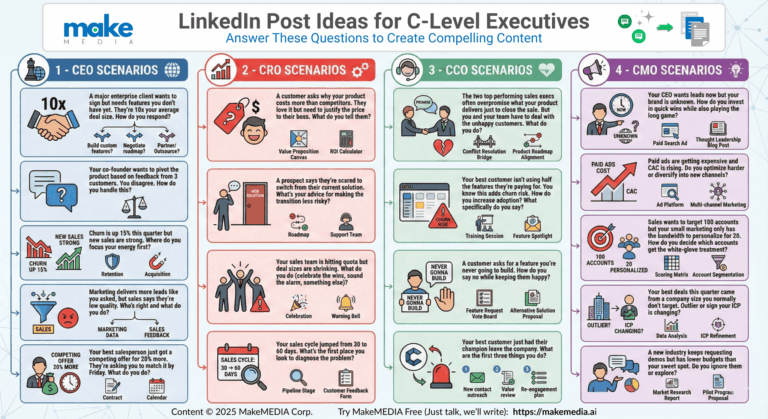
This list of LinkedIn post ideas is designed to make content creation for executives easy and generate posts that aligns with what your audience wants. It’s easy because it’s far simpler to answer a question than to stare at a blank screen.
Flip your phone to record, then answer any of the questions in this list in your own words.
You’ll be done in 90 seconds.
And have a wonderful LinkedIn authentic post that builds your brand and drives business.
Table of Contents
Executive Content Ideas: The Real Problem
I talk to C-suite executives and VPs every week about which LinkedIn post ideas generate the most impact. They’re struggling with executive content creation and all say the same three things:
- “I don’t have time.” Between board meetings, customer calls, and team management, writing falls to the bottom.
- “I don’t know what to write.” The blank page is intimidating.
- “I’m silently afraid of what people will say – and trolls.” This is one they won’t always admit, but it’s a real fear. (Side note: Most people on LinkedIn are respectful. I get trolls now and then. Easy fix: don’t engage, just block them and move on with your life.)
If any of these situations describes you (or someone on your team who you want to encourage to post), bookmark this page.
It’s the simplest guide to creating compelling executive content that you can use immediately. (An expanded version of of the infographic’s content is below.)
The Solution: Answer Very Specific Questions
The expertise and insights already exist in your head. You know how to hit aggressive growth targets. You’ve coached teams through difficult quarters. You’ve made decisions that others could learn from.
The problem isn’t missing knowledge. It’s that asking “What do you want to post about?” requires too much cognitive effort.

You have to figure out what’s relevant, what your audience cares about, and how to position it. That’s a lot of work when you’re already stretched thin.
Ask a CRO: “How do you determine if a 30% growth target is realistic while still being a stretch goal?” Suddenly, they have a lot to say. The expertise flows because the question is specific and contextual.
The infographic from this article presents scenarios that you’ve seen and experienced. Each box is phrased with a question and a graphic to help you answer quickly. Turn your answers into authentic posts by doing any one of these options:
- OPTION 1: Record yourself answering the question on your phone, then post it.
- OPTION 2 (easiest): Create a free MakeMEDIA account, click “Quick Idea”. Then read the question out loud and answer it. MakeMEDIA will ask relevant follow-up questions and then transform your words into numerous posts and a newsletter in minutes.
- OPTION 3: Have a colleague ask you the question and record you answering it, then post.
TIP: Add stories from your lived experiences as you answer a question. It dramatically boosts authenticity and relatability.
For quick reference, below are expanded versions of these scenarios and questions in text format for each of the four C-Level executive roles from the infographic.
1. Scenarios for CEO LinkedIn Post Ideas

- A major enterprise client wants to sign but needs features you don’t have yet. They’re 10x your average deal size. How do you respond?
- Your co-founder wants to pivot the product based on feedback from 3 customers. You disagree. How do you handle this?
- Churn is up 15% this quarter but new sales are strong. Where do you focus your energy first?
- Marketing delivers more leads like you asked, but sales says they’re low quality. Who’s right and what do you do?
2. Scenarios for CRO LinkedIn Post Ideas

- A customer asks why your product costs more than competitors. They love it but need to justify the price to their boss. What do you tell them?
- A prospect says they’re scared to switch from their current solution. What’s your advice for making the transition less risky?
- Your sales team is hitting quota but deal sizes are shrinking. What do you do (celebrate the wins, sound the alarm, something else)?
- Your sales cycle jumped from 30 to 60 days. What’s the first place you look to diagnose the problem?
- Your best salesperson just got a competing offer for 20% more. They’re asking you to match it by Friday. What do you do?
3. Scenarios for CCO LinkedIn Post Ideas

- The two top performing sales execs often overpromise what your product delivers just to close the sale. But you and your team have to deal with the unhappy customers. What do you do?
- Your best customer isn’t using half the features they’re paying for. You know this adds churn risk. How do you increase adoption? What specifically do you say?
- A customer asks for a feature you’re never going to build. How do you say no while keeping them happy?
- Your best customer just had their champion leave the company. What are the first three things you do?
4. Scenarios for CMO LinkedIn Post Ideas

- Your CEO wants leads now but your brand is unknown. How do you invest in quick wins while also playing the long game?
- Paid ads are getting expensive and CAC is rising. Do you optimize harder or diversify into new channels?
- Sales wants to target 100 accounts but your small marketing team only has the bandwidth to personalize for 20. How do you decide which accounts get the white-glove treatment?
- Your best deals this quarter came from a company size you normally don’t target. Outlier or sign your ICP is changing?
- A new industry keeps requesting demos but has lower budgets than your sweet spot. Do you ignore them or explore?
Closing The Authenticity Gap
Don’t copy/paste any of these questions/scenarios into ChatGPT or other AI tool. Generic AI tools take a one-liner and generate LinkedIn Post Ideas that might be grammatically correct, but not authentic. It doesn’t sound like you because it doesn’t know you.
This is why we built MakeMEDIA’s executive onboarding process. In our initial setup, we learn:
- Your professional background and current role
- What you are and want to be known for
- How you lead and coach your team
- Causes that matter to you
- Things that make you, well, you
That context enables us to ask pointed follow-up questions that tap into the deep recesses where your best insights live. It also pulls out stories from your experiences.
Try this question-based approach for creating authentic high-performing content. It will help you articulate expertise you didn’t even know you could share.
