
Your SaaS content strategy needs more than random blog posts and basic product information to succeed. Building a content marketing plan that maps to each stage of the buyer journey helps you connect with decision-makers while improving your search rankings.
A structured content framework gives you the tools to create targeted materials that speak to distinct buyer personas, align product features with customer needs, and showcase real success stories. This guide shows you how to build a repeatable system that brings qualified leads to your business while establishing your team’s expertise.
Table of Contents
Strategic SaaS Content Mapping
Publishing high-quality content consistently is one of the best ways to increase your brand recognition and attract qualified leads into your funnel. You need to create a SaaS content strategy that can scale because developing good content isn’t a one-and-done thing.
Many websites just have information about themselves with an occasional blog post that quickly becomes outdated. By publishing on a regular basis, you generate signals to Google’s algorithm and showcase your thought leadership to your prospective audience.
Check out our guide: Content Marketing Template and Framework for B2B Sales
Understanding Your Buyer’s Unique Needs
A strong SaaS content strategy starts with understanding your buyer’s unique needs. Your framework should map specific content to each of your customer journey stages, helping potential customers see how your product solves their problems. The key is to create content that speaks directly to the different decision makers while keeping your core message consistent.
Creating Accurate Buyer Personas
The first part of the strategy is to create accurate buyer personas. MakeMEDIA enables you to do this quickly, but if you want to do it on your own, start by gathering insights through customer interviews and sales team feedback. Each buyer persona needs distinct content that addresses their specific challenges. Here are a few examples:
- A chief financial officer is likely going to focus on return on investment and reducing costs
- A chief technology officer would care more about technical integration and scalability
- An end user might be more concerned about the user interface, ease of access to support teams, and the onboarding process
As you develop content, every piece you write or create, even videos or social media posts, should address the persona you are targeting. Build detailed profiles that capture each persona’s job responsibilities, challenges, pain points, influencers, information sources, and key messaging points. This will allow you to create targeted content that resonates with every audience segment.
Matching Product Features to Customer Problems
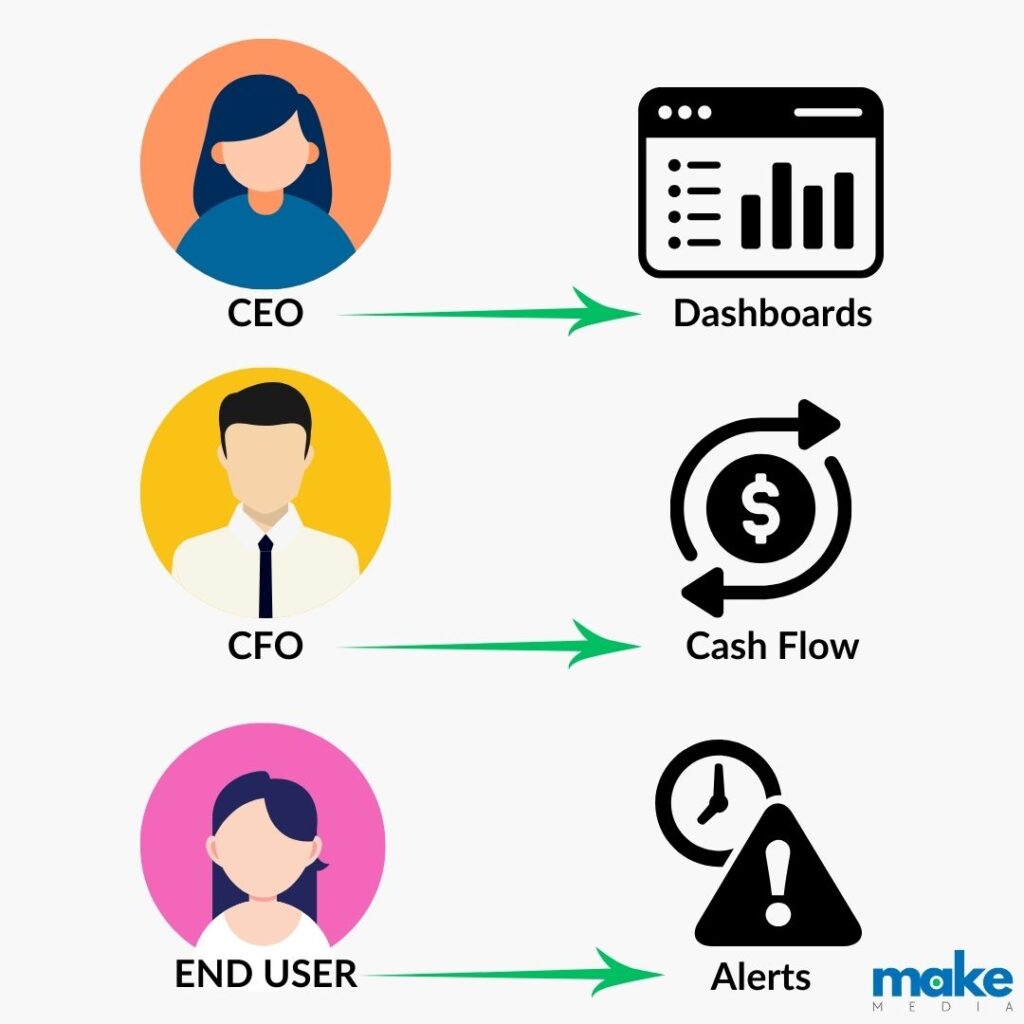
The next step is to match your product features to specific customer problems. Your goal is to show how each feature delivers tangible benefits.
Think about it like this: a project management tool might highlight its automation features for operations managers but focus on reporting capabilities for executives. If you’re writing a piece for a CEO, talk about the dashboard and how it enables informed decision-making.
Keep in mind that your audience is buying the benefits of what you sell, not the features. Companies often get caught up in talking about their feature set and miss the mark on what matters most to their clients.
Imagine a company that manufactures drill bits. They don’t sell 1/4-inch drill bits – they’re selling 1/4-inch holes, which is the benefit people are buying. When you focus on the benefits, it helps your audiences quickly understand the value your product brings to their specific role.
Organizing Content Around Main Themes
Once you’ve noted your content-product alignment, your SaaS content strategy should focus on organizing your content around main themes that make a difference to your buyers. This is often called pillar content. Each pillar should connect to specific customer challenges, and your buyer personas will help you line that up quickly. The goal is to create topic clusters that answer common questions and showcase your expertise.
Example:

Let's say you're a cybersecurity company. You could create a security compliance pillar with related topics about data protection, regulatory requirements, and best practices. This structure helps buyers find relevant information while establishing your authority in your field and making potential buyers aware of your products and services.
Sharing Real-World Success Stories
One of the most important components of a high-performance SaaS content strategy is sharing real-world success stories. Your prospects want to see their lives playing out in the stories you share. Talk to your existing customers to develop case studies that point out specific challenges they’ve had and how they’ve solved them using your solutions. Focus on the transformative journey they experienced and the measurable outcomes, using as many metrics as possible.
You can include details such as:
- Team adoption
- Implementation milestones
- 30-60-90 day plans
- Onboarding experiences
- Other things that will resonate with each targeted buyer persona
To illustrate, you could describe how a marketing team improved their workflow efficiency or how a finance department gained better budget tracking capabilities using your tools.
Capturing Expert Knowledge for SaaS Content Creation
Every SaaS company has competitors. Yours is no exception. How do you stand out in a sea of competition? This is where your SaaS content strategy will help you shine. You want to showcase your expertise, not just in the product that you offer, but as a resource to help customers and prospects articulate and think through ways to overcome their challenges.
Learn more: B2B Go-To-Marketing Strategy Guide
Tapping into Subject Matter Experts
The best way to showcase your expertise is to share subject matter expertise. You may be one such expert yourself, or you may have executives on your team with specialized skills. Extract expert knowledge through structured interviews that help the subject matter expert share the nuanced details of their knowledge. Here’s how to do it:

Preparing for the Interview
The first step in capturing this knowledge is preparing an interview. A strong preparation system starts with:
- Creating a template
- Researching talking points that the expert can discuss
MakeMEDIA can do all of this for you in one minute. Using a very methodical process and structured frameworks, it will come up with content ideas and detailed outlines with questions that help experts share what they know. This ensures that your content aligns with the buyer journey stage that your prospect is in as well as the buyer persona you are targeting.
Capturing the Expert’s Words
The next SaaS content strategy step is to capture the expert’s words. For most people, having a conversation is a lot easier than writing. That’s where the beauty and simplicity of MakeMEDIA comes in.
MakeMEDIA will provide talking points similar to a slide deck that an expert might use when giving a presentation. It will also provide very specific lines they can use in case they get tongue-tied in figuring out what to say.
Creating Unique and Original Content
Once the expert completes their interview, which can take 10 to 15 minutes, MakeMedia will create a high-quality article. This article incorporates the stories, case studies, use cases, examples, and insight that the expert shared in the interview.
Run an agency? Grow faster: 5 Growth Tactics for Your LinkedIn Content Agency
What makes this content unique and original is that it’s not built from AI training data that most AI content generators use. When Google sees your content, it will know that the stories you shared and the analysis you offered are not regurgitated information written with different words. It will recognize that your content is unique and provides value, which aligns with their E-E-A-T guidelines for creating helpful content.
SaaS Content Performance Analytics Framework
Once you publish your content, you might be wondering about the effectiveness of your SaaS content strategy. Your metrics involve more than simply page views or leads generated, although the quality of your leads is certainly one of the most important factors. Here’s how you can start collecting metrics about the usefulness of your content.
Setting Up Analytics Tools
If you haven’t already done so, install Google Analytics and Google Search Console. These are free tools that Google provides to help you understand how people are getting to your website and what they do once they’re there. In all of my companies, we’ve used heat mapping tools to show exactly where readers engage the most on key pages. It shows where their cursor dwells and where they tend to click.
Lead Conversion Funnels and Scoring

In our content strategy for SaaS, we use lead conversion funnels such as exit intent pop-ups or slide-ins to offer guides or downloads that our visitors can get in exchange for their email address. We track what when they enter our funnel based on where they might be in their customer journey stages.
Here’s our proven approach: if a prospect is in the awareness stage, which is the initial stage that many people start at, we then send a follow-up email with content meant for a later stage, such as a case study. If they click that, it sends us a signal that they’re likely at a later stage than we initially thought based on the download they did.
Using a marketing automation system can help you take care of that, and there are many of these tools around. They also have lead scoring that can help you determine how qualified one of your leads is. Lead scoring is when you assign points based on activity, such as:
- 1 point for opening an email
- 2 points for clicking a link
- 5 points for setting up a demo
The actual number of points doesn’t matter as much as the weighting of your points because someone who requests a demo is clearly much farther down the funnel than someone who is looking at your general educational information.
Keyword Research and Competitor Analysis
One of my favorite tools to use for tracking other topics we should be talking about is SEMrush, which gives you insight into keywords, their search volume, and keyword difficulty. It also provides insights into backlinks and referring domains, so we can research our competitors to see where they’re getting their backlinks from and create outreach strategies to try and get links from those domains as well.
Conversion Rate Optimization
Another thing to track in your SaaS content strategy is which pages are converting the most. If you have a page that generates a lot of traffic but you don’t get a lot of leads from it, start creating A/B tests where you make small modifications to the page to see if that improves your conversion rate.
Here’s a simple tactic we used on one of our sites, morebusiness.com, which has quite a few sample business plans available for download. We created PDF versions of the full detailed plan that the visitor is reading and offered that as a download. You might think that people could simply copy and paste the page they’re reading, but you would be surprised to know that we get dozens of people requesting the downloadable version every day, which allows us to build our email list and send them follow-up messaging through marketing automation.
Content Gap Analysis
Another value that using tools like SEMRush, Moz, or Ahrefs allows you to do is a content gap analysis to see what kinds of content your competitors are publishing that you might also want to pursue. In one of my companies, WealthEngine, I noticed that one of our competitors was ranked for over 1,000 terms. It was clear that they had hired an SEO agency to help them get online traction.
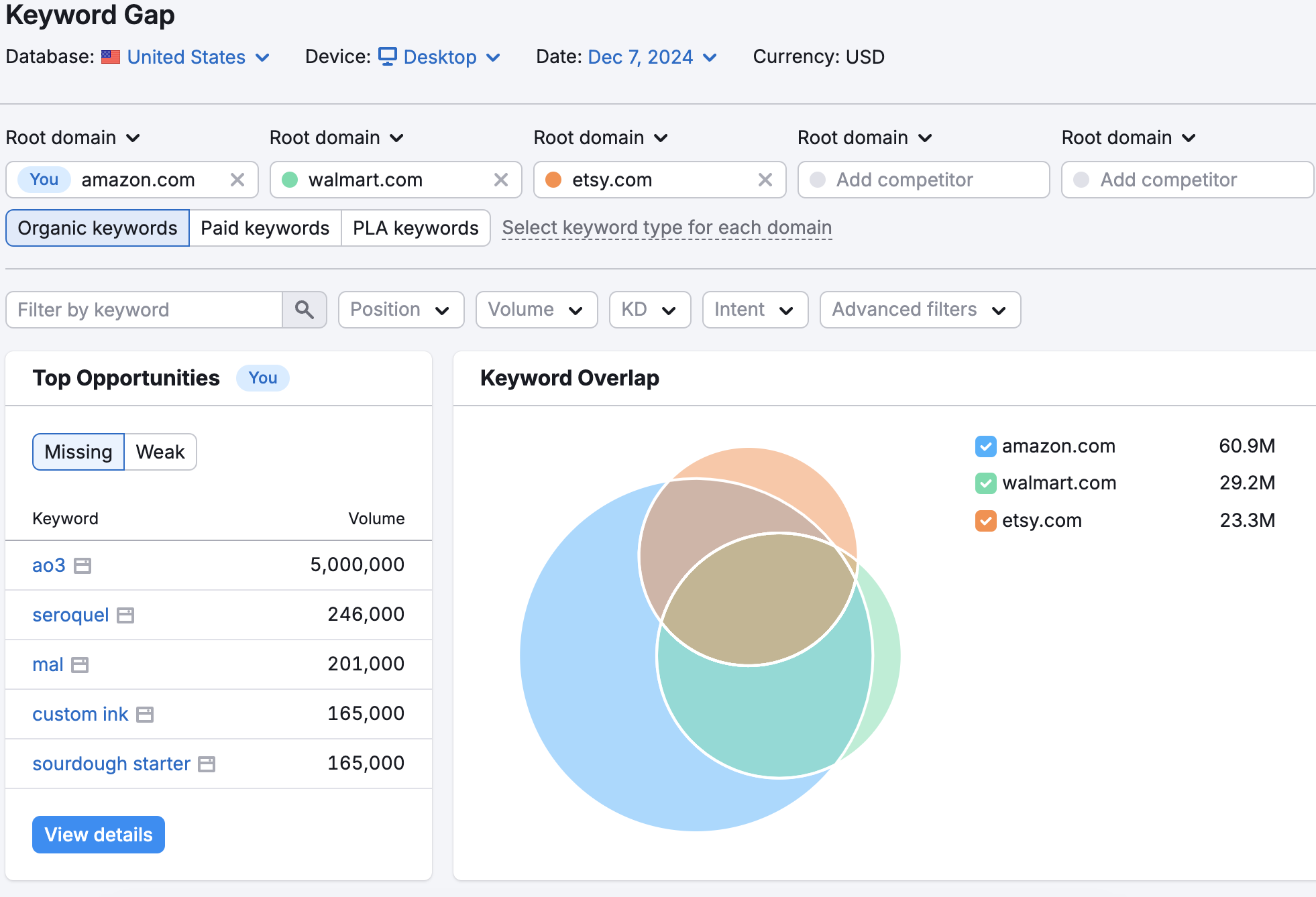
I used SEMrush to see which keywords they were ranked on, which ones had low difficulty and good search volume, meaning in our case over 100 people a month were searching for the term. I downloaded the data, put it into a spreadsheet, quickly sorted based on terms that had low keyword difficulty and high volume, and then looked at where our competitors were ranking for those terms as well as the content they published to achieve their ranking slot. This provided a straightforward approach for us to figure out what kind of content we should be producing.
Let me give you an example of how this played out. One of those terms was “donor pyramid,” which is a technique that nonprofit organizations use to determine how much money they can raise in a fundraising campaign. This was the exact market we wanted to target, yet we didn’t have content around the topic of donor pyramid. I also noticed that there were related keywords such as “gift pyramid,” “gift table,” and a few others that all meant the same thing and collectively had good search volume.
My team and I drafted a very detailed article which quickly rose to page one and eventually to the number one slot on Google for this term. It has since generated very high quality leads that turned into paying clients. By focusing on the right metrics and using the appropriate tools, you can optimize your SaaS content strategy for maximum impact and lead generation.
Multi-Channel SaaS Content Distribution System
To create an effective content strategy for SaaS, you need a strong content distribution approach. The most important thing to remember is to publish consistently. Many small companies start publishing content but quickly realize they can’t keep the pace up and then stop. When a visitor looks at their site, they might find outdated information or nothing that talks about current trends. This is a big missed opportunity because if you added SEO to your content, it will start to attract qualified traffic.
See our SEO Best Practices Checklist
Be Active on LinkedIn
If your target is B2B, you need to be active on LinkedIn. This is becoming table stakes. The magic of MakeMEDIA is that when you use it to create content for your blogs or guides, you automatically get very high quality social media posts that include a strong hook and a trailing question to encourage engagement. You can talk about things such as:
- The problems your customers are facing
- New information about your company
- Personal stories that people relate to
Including a mix of content is important, but don’t publish random thoughts. Pick a handful of themes, say 4 or 5, and stick to them.
Publish New Content Effectively
When you publish new content, don’t simply put a link to your new blog. Instead, add a longer note that talks about the gist and then encourage people to read the full blog.
Pro Tip: Put a link to your blog in your LinkedIn comments and not your main post.

See our executive guide: AI-Powered LinkedIn Content Strategy
Research suggests that LinkedIn will not show your post to as many people if you have a link in the post itself, which is why it’s better to put it in the comments.
Want to see a live example of how to make this work? You can follow me on LinkedIn. I post almost every day and include a wide variety of topics that center around our business, the problems our audience faces, and a feature I call Startup Diary, which includes what I call the victories and screw-ups of startup life. Those are quite often my most popular posts because they resonate with so many other startups who may be experiencing similar challenges as they build their companies.
Create a Publishing Schedule

Another part of your SaaS content strategy is a publishing schedule. Your SaaS content calendar should take into account all of your different channels to really create the momentum that will help you connect with a broader audience. If you are just getting started, the most basic channels to use are your blog and LinkedIn.
Rethink Your Blog
A quick note on your blog: Think about the last time you went to a website and clicked on a link that had the word “blog”. You probably skip over that thinking that the content on someone’s blog might not be high quality, am I right?
Instead, if the word “blog” in your navigation bar was rephrased to “best practices” or “how to”, you might have a higher likelihood of clicking on it because those words are more inviting than the word “blog”.
Expand to Video, Webinars, Podcasts, and Livestreams
As you get more comfortable with content creation, you should add YouTube and posting videos on LinkedIn. LinkedIn is starting to reward those who post vertical videos, which you can record fairly quickly on your phone and publish with minimal editing.

Trying to stay active on all the channels available to you is a very time consuming task. My recommendation is to focus on two or three or starters and then add more as your SaaS content strategy develops.
My preferred channels are: blog (which we call Best Practices), LinkedIn, and Youtube.
The benefit of LinkedIn and Youtube is that you can do a livestream to both channels and viewers can tune in from their preferred channel. Youtube instantly archives your livestream for future viewing – or you can disable that feature.
A livestream is like a webinar but with optional registration. While you might not capture as many email addresses than with a webinar, prospects can tune in easily and interact through the channel’s chat options. You can then release your recording as a podcast, which will increase your distribution.
Reach Your Audience Where They Are
The goal here is to reach your audience where they are. Some will be going to Google to search on topics they’re thinking about and find your website and educational articles. Others are lurking on LinkedIn looking for educational information or comments by the people in their network. Even others listen to podcasts or enjoy webinars and livestreams as a way to learn about trends and educate themselves on new products.

At MakeMEDIA, quite a few clients find us from our LinkedIn posts because we talk about how to solve challenges that they’re facing in scaling their SaaS content strategy and we show them ways to solve those challenges. We also talk about these topics on our videos and in LinkedIn carousel posts and of course on our website with long-form educational content.
MakeMEDIA automatically embeds SEO keywords strategically throughout the articles it generates from your interview, so the hardest part of doing SEO is automatically tackled for you. This wide SaaS content distribution approach enables your prospects to find you when and where they are. It also keeps you top of mind as an authority not only in your industry, but as well as a strong option that your prospects should consider when they’re looking at SaaS vendors.
Scale Your SaaS Content Strategy With Expert AI Support
Your content strategy grows stronger with proven tools and expert support. MakeMEDIA’s AI-powered platform helps you capture knowledge, create targeted materials, and maintain a consistent publishing schedule that builds trust with your audience.
It enables you to scale content production while keeping quality high. Try it free to learn how we can help you build a content system that brings qualified leads directly to your business.
