

LinkedIn saw AI search stealing their traffic and built an AI search strategy for B2B to get theirs back. In this article, the person who designed their playbook, LinkedIn’s Brooke Weller, walks you through their process: how to rank in AI search, the content patterns AI engines actually cite, the URL tactic hiding in every LinkedIn post, and what she would do with one hour a month of any executive’s time to boost brand visibility inside AI.
If you own your company’s brand, comms, or marketing, this article and the accompanying podcast episode is your operating manual.
Table of Contents
Brooke is LinkedIn’s own AI Search Strategist. She built their internal AI search content strategy playbook, a 23-page guide that spread across the company and became the external practitioner’s guide LinkedIn now publishes for B2B marketers. She joined me on the Executive Signal podcast below, and shared a blueprint any B2B team can start using this quarter.
Why LinkedIn Built an AI Search Strategy for B2B in the First Place
LinkedIn started its AI search program after traffic to its websites dropped.
In a post on LinkedIn’s marketing blog, Inna Meklin, their Director of Digital Marketing, and Cassie Dell, Group Manager of Organic Growth, reported that non-brand, awareness-driven traffic fell by up to 60% across a subset of B2B topics industry-wide. The post says click-through rates softened while rankings stayed stable.
When rankings hold and clicks fall, AI answers are doing the work your website used to do. See how buyers now build vendor shortlists before they ever call sales in our guide:

Owning the Invisible Modern B2B Buyer Journey
LinkedIn treated AI search as a job for every team. Inna Meklin formed an AI search task force that pulled one person each from SEO, social, content, PR, and paid media, because social posts, earned media mentions, review profiles, website copy, and employee content all feed the same LLMs.

A note for CMOs and Heads of Communications: Earned media now depends on the brand mention more than the backlink. Your social media manager has a key role in optimizing your LinkedIn presence. A complete AI search strategy for B2B needs all of those people at the table alongside your SEO team.
Brooke also wrote a 23-page internal guide that codified AI and SEO best practices across LinkedIn’s microsites: FAQ formatting, schema markup, llms.txt files, and content consolidation. A coworker turned it into an AI tool that audits pages against those practices, and teams still use it when their LLM visibility softens on a topic. The guide later became the public guidance LinkedIn now publishes for B2B marketers.
What LinkedIn Changed on Its Own Pages
Now for the meaty stuff you’re going to love learning about.
Brooke said LinkedIn’s microsites had strong imagery and a clean user experience, and the team’s first job was adding the substance those pages lacked. For every page, the team asked:
- If I were an LLM or a human reading this page, what information am I not getting?
- Does that information live somewhere else on our sites?
- Can we consolidate pages to put it in one place?
To decide what each page should answer, the team used AI visibility tools to reverse-engineer the prompts competitors were showing up for. If a competitor appeared for a question and LinkedIn’s page had nothing on it, the team added content that flowed naturally with what was already there.
Ask of every page what an LLM or a human would still be missing after reading it. Our content chunking guide shows how to structure pages so AI can pull the answer.
Adding FAQs to many pages produced a large lift in LinkedIn’s AI visibility, and improvements to schema, metadata, and the llms.txt file each added more. LinkedIn’s team also consolidated pages, cutting a large number of underperforming URLs even though traffic was already declining. That was a calculated risk. Brooke said the team knew it was the right move, and she credited Cassie Dell’s grasp of how LinkedIn’s microsites fit together.
Brooke said what works for LinkedIn may not work for your site, so test on a few pages first and roll out the winners more broadly in the next round. She also noted that pages written entirely as questions and answers are hard for people to read, so LinkedIn keeps a brand blog written for people and nests Q&A-style pages inside product and solution sections for LLMs. You are writing for humans and machines at the same time.
How LinkedIn Content Earns AI Citations
LinkedIn is now one of the most cited sources in AI answers, and Brooke’s team tested which posts and articles get pulled into AI.
Why LinkedIn AI Visibility Is Your New Baseline
Two 2026 studies put LinkedIn near the top of AI citations. A Meltwater study that analyzed 9.5 million AI citations across 16 B2B categories ranked LinkedIn second behind YouTube, and a Semrush study of 89,000 LinkedIn URLs found LinkedIn in roughly 11% of AI responses.
Research from 6sense, cited by Meltwater, found that 94% of B2B buyers now use LLMs during their buying process, and Search Engine Land reported that LinkedIn has become a top source AI tools draw on for B2B research. This means any credible AI search strategy for B2B has to account for LinkedIn.
Semrush’s breakdown of cited LinkedIn content:
| Content format | Share of AI citations | Where I’d use it |
|---|---|---|
| Long-form articles (500 to 2,000 words) | Approximately 65% | Industry analysis, how-to guides, expert Q&A |
| Short-form posts (50 to 300 words) | Approximately 25% | Timely takes, customer stories, single-point insights |
| Reshares | Approximately 5% | Engagement only, low citation value |
About 3 of every 4 LinkedIn citations in AI answers point to a person's profile post, not a company's post.
Meltwater found that about 75% of LinkedIn’s AI citations come from individual member profiles and 25% from Company Pages, and more than half came from members with fewer than 10,000 followers. Brooke’s team still sees strong citation results from LinkedIn’s product showcase pages, so she recommends doing both. As she put it in the podcast: “LLMs don’t discriminate. A smaller brand with the right content can get in.”

Semrush found that the LinkedIn posts AI cites typically draw modest engagement, and my own posting experience shows this, too.
My origin story posts get far more likes, while my how-to posts, trend analysis, and instructional content lead to business. At networking events, people walk up and say, “Raj, I loved that post about how to do XYZ,” and we pick up the conversation where the post left off, even though many of them never clicked Like. When I wrote about Gen Z job worries as a parent of two Gen Zers in their 20s, the CEO of a $1.5 billion company joined the discussion.
The Content That Earns AI Citations
LinkedIn’s data team studied which content gets cited and why. The winners were education content, how-to content, voice of the customer, and narratives only your company can tell. Brooke shared her own theory for why, and she was clear that it is her personal opinion rather than an official LinkedIn position. In her view, LLMs have already absorbed most of what is on the web, so they reach for something new that hasn’t already been repeated. Commodity answers to basic questions no longer stand out.
Content types that earn AI citations on LinkedIn:
- Education and how-to content tied to your product category
- Voice-of-the-customer narratives drawn from real conversations
- Founder origin stories and personal perspectives
- Sales call Q&A repurposed as long-form articles
Your sales calls already hold the questions buyers ask AI. Read MakeMEDIA's B2B content creation workflow, which helps busy teams turn raw material like that into published articles.
Brooke also suggests treating LinkedIn as a second owned platform, so the newsletters and research you already send customers can go on LinkedIn without building the channel from scratch. She pointed to recorded sales calls as a strong source of LinkedIn content. As she put it: “Every week, grab seven sales calls and turn them into a LinkedIn article.”
Your prospects are already asking specific questions on those calls. Your team is already answering them. Turning those Q&A exchanges into LinkedIn articles creates the exact type of content that LLMs cite: specific, question-driven, and representing knowledge that has not been recycled from existing training data. Building this into your content marketing plan is a fast way to grow citation-ready content.
How LinkedIn Post URLs Affect AI Discoverability

Brooke also explained how LinkedIn builds post URLs. When you publish a LinkedIn post without hashtags or an image, the first line of your post becomes the URL. That means you can control the URL by writing a first line that matches the questions buyers ask AI.
LinkedIn found this by testing its own platform. The team ran every type of post from its own accounts to see what showed up in AI answers, and called it customer zero testing. These are the tactics that came out of that testing:
- Write the first line of your post as the question buyers ask AI. LinkedIn’s team used lines like “How to leverage LinkedIn for AI visibility.”
- Answer that question in the body of the post, because LLMs pull answers into their responses.
- Skip hashtags if you want the first line to become the URL. On posts, LinkedIn uses hashtags for the URL no matter where they appear.
- If you use hashtags, write them as phrases that match a real question, such as “use AI to make your videos,” instead of labels like “#MakeMEDIA #2026 #WereAwesome.”
- For LinkedIn articles, fill out the SEO fields and write a question-driven title, since the title becomes the URL when the article auto-posts.
- Stay on one topic for a month or more, so your posts and articles build a clear category entity that LLMs connect to your name.
- Skip aggressive hooks as your opening line. They produce URLs with no meaning and posts with little for an LLM to cite.
When LinkedIn’s thought leadership team shared its AI visibility guide, first lines read like “How to leverage LinkedIn for AI visibility,” the same wording buyers type into an LLM. The guide’s published title uses nearly the same words. Authentic content with keyword-aligned first lines is what gets pulled in.
The B2B Buyer Journey Now Runs Through AI
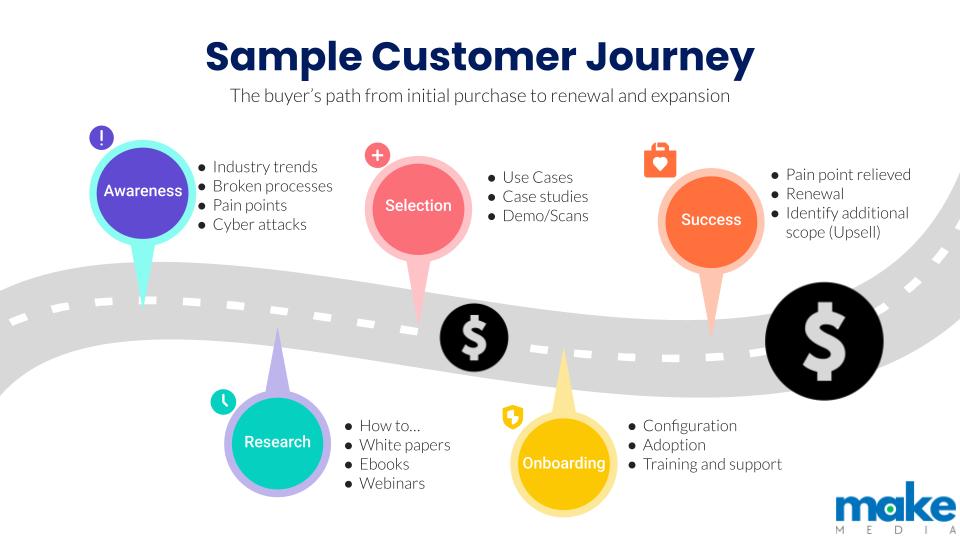
The B2B buyer journey used to take months of demos, comparison spreadsheets, and pricing negotiations. Today, a buyer describes a problem to an AI chatbot, gets a consideration set of 5 brands, maybe more, and asks for feature comparisons, pricing breakdowns, and a formatted document for their CTO in that same conversation. If you are not in that initial consideration set, you never get a chance to pitch.
If you are in the list but your product information is inconsistent across review sites, social profiles, and your website, the AI fills the gaps with outdated or inaccurate data. LLMs pull pricing from Capterra listings that clients had not touched in years. Imagine losing a $60,000 to $120,000 SaaS deal because an AI chatbot quoted your competitor’s pricing accurately and pulled yours from a page you forgot existed. The upside is that LLMs weigh content quality and relevance over brand recognition.
Why Executive Thought Leadership Earns AI Citations
Company Pages account for about a quarter of LinkedIn’s AI citations. The rest comes from real people’s profiles: founders, product leaders, CTOs, and CMOs. Executives who post regularly build the kind of topical association that LLMs reward.

For companies with limited time, Brooke recommends recording a one-hour Q&A with your CEO, CMO, CTO or other executive each month. Ask how they started the company, what pain points their customers have, and what questions customers are asking. I love the way she characterized this: “Founder stories are going to become more valuable as the pool of original knowledge shrinks.”
For the rest of the program around these recordings, including KPIs, buyer personas, and measurement, see my CEO’s guide to content marketing.
A 90-Day Plan to Build a B2B AI Search Strategy
Brooke’s advice for a 90-day plan starts with getting your house in order, then testing changes on a few pages and rolling out what works. I added a content phase in the middle based on her sales call and executive Q&A advice. The plan below maps to an SEO best practices checklist framework:
| Phase | Timeframe | Actions | Expected outcome |
|---|---|---|---|
| Audit | Days 1 to 30 | Fix brand messaging across LinkedIn profiles, review sites, and your website. Add FAQs and schema markup to key pages. Deploy an llms.txt file. | Prevent AI hallucination about your brand. Establish a clean baseline for your AI search strategy. |
| Content | Days 31 to 60 | Launch a weekly pipeline converting sales calls into LinkedIn articles. Post one executive Q&A article per month. | Build citation-ready content that only your brand can produce. |
| Test and scale | Days 61 to 90 | Publish comparison pages addressing “your brand vs. competitor” and “your brand vs. AI tool” queries. Track AI visibility changes. Roll out what works across more pages. | Earn AI citations. At MakeMEDIA, comparison pages appeared in AI responses within one day and still hold months later. |
What to Include in Your Brand Consistency Audit
Before creating new content, fix what is broken. Use this audit checklist:
- Review all LinkedIn profiles (personal and company) for current, accurate messaging
- Update review site profiles (Capterra, G2) with current pricing and feature descriptions
- Align website product descriptions with LinkedIn and review site content
- Verify that executives’ personal profiles reflect current roles and areas of focus
- Deploy an llms.txt file on your website
- Add FAQ sections to key product and service pages
- Review and update schema markup across your site using an SEO content analysis tool
Also, see our AI Reputation Management Guide →
Why Comparison Pages Get Cited by AI So Fast

One tactic I tested at MakeMEDIA produced results faster than anything else. We published pages comparing MakeMEDIA vs ChatGPT and MakeMEDIA vs Claude. Within one day, those pages were cited in AI responses. Months later, they still hold. You can see the full results in our AI search optimization case study.
AI citations tend to fade over time, but those comparison pages have held on, which tells me they carry real weight with LLMs. Many companies avoid naming competitors on their own site, even though people are typing those comparisons into AI anyway. If you want a say in what the answer says, publish the comparison yourself.
⚠ If you skip writing a comparison page, an LLM will write the comparison for you.
The reason this works so well for AI-native companies is that prospects are already asking, “Can I just do this in ChatGPT?” If you do not answer that question on your own terms, the LLM will answer it for you, often with inaccurate information.
If you are ready to build your LinkedIn content strategy around these principles, the Executive Signal podcast episode with Brooke Weller goes deeper on every one of these tactics.
How to Use MakeMEDIA for Authentic Content Every Week

This AI search strategy isn’t just for product firms. If you run a professional services company, like a law firm, CPA practice, a marketing agency, or an HR/benefits firm, and your partners have not posted LinkedIn articles addressing the questions your clients ask every quarter, take a moment to build that content quickly. Those questions are the exact content LLMs are pulling into responses.
MakeMEDIA turns expert conversations into high-performing content for your AI search strategy. This article’s first draft was created by dropping the podcast recording into MakeMEDIA. It saved us over 8 hours of writing/editing time because the original material covered in the recording was carefully repurposed, then edited for this article’s final draft.
Get a personalized demo for your team to see how you can repurprose your content for your AI search strategy:
