

Your pipeline as a fractional CTO tends to run dry at the exact moment you have no time to rebuild it. Marketing your technical services isn’t usually on your mind – and you probably don’t enjoy it either. You land a strong engagement, put your head down to deliver, and look up a quarter later to find no new contracts ready to start after this one finishes. Then the scramble begins, and you don’t want to do cold outreach.
The usual advice points you to send 20 DMs a day, build an outbound machine, and now maybe add an AI SDR bolted on top. That playbook was built for a company with a sales team and a quota, not for one technical operator whose calendar is the product.
The lever you actually control is your own expertise, made visible. The fractional CTOs who stay booked put their thinking in public, showing prospects how to solve the hard problems those prospects are already stuck on. Referrals and reputation compound on top of that proof.
On this episode of Executive Signal, Nicholas Tolson, who runs an AI consulting practice called Razzo, walked me through how he books strategic work this way, without ever sending a cold message. What worked for him lines up with what I saw building and selling three companies, and it is the same idea MakeMEDIA is built on: your expertise is the asset, and content that shows it in action is what brings the right clients to you.
Table of Contents
Your Time Is Your Product
Your product is your time. That is the whole inventory, and it does not scale the way a software company does.
A B2B SaaS company needs a constant pipeline because its sales team has a quota to feed. As a fractional CTO, one client means a lot, and an outbound system that drops forty leads on your calendar in a week hands you a delivery problem with your name on it.
Consulting tends to run on a feast and famine rhythm. You get busy, the marketing stops, and the pipeline empties right as you surface for air. Doing this well means flattening that curve, so the next conversation is already underway before the current project ends.
Nicholas describes the failure mode with an old UPS Super Bowl spot, where the team cheers as the orders pour in, then panics because there is no way to fill them.
The table below is a positioning decision rather than a menu. Pick one, and the rest of how you win fractional CTO clients follows from it.
| Dimension | High-Volume Outbound | Expertise-Led Content |
| Built for | A team with a sales quota to feed | One expert whose time is the product |
| What you control | How many messages you send | What you teach and how deeply you show it |
| What it produces | More leads than you can serve | A few right-fit clients who arrive already convinced |
| How trust is built | You claim it in a pitch | Prospects watch you solve their problem |
| Fit for a fractional CTO | Rarely | Almost always |
What you want is a steady simmer, enough of the right conversations to keep your calendar full at the pace you choose. Dead weeks stop appearing when the flow is built that way.
Content That Shows You Solving the Problem
The part of your pipeline you actually control is the content you put out, so it is worth getting right. Nicholas builds his around a real problem his prospects are stuck on and shows himself solving it, step by step, with the tools they already use. In his case that tool is often Claude or another language model, though the same move works with Excel, Salesforce, or whatever a given CXO leans on every day.
Think of it as a demo with no sales pitch attached. He shares his screen, walks through the actual task, and lets you follow along and do it yourself.
The problem is usually complex enough that watching someone competent work through it is useful on its own. By the end, you have watched an expert think through something you are facing, which does more than any pitch could.
A demo with no pitch:

1. Share your screen
2. Solve a real problem
3. Let the work make your case
That is exactly how I reacted to his posts. I found myself thinking I want to work with this person before he had pitched me anything, because the depth on his profile made his expertise impossible to miss. A prospect who reaches that point has already done most of the work of qualifying you.
A few things make this kind of content pull qualified clients:
- Pick a problem your prospects are actually stuck on, not a topic that flatters you
- Solve it in the open, step by step, using the tools they already work in
- Show your screen or your reasoning so the expertise is visible rather than asserted
- Leave the pitch out, because the demonstration is the argument
The hard part is doing this often enough to matter. Much of the expertise a fractional CTO has is already in their head, in a recorded call, a solved ticket, or a conversation like this podcast. Turning that raw material into content that shows the work is the real bottleneck, and it is the one MakeMEDIA was built to remove.
To Build Authority, Make It Unmistakably Yours
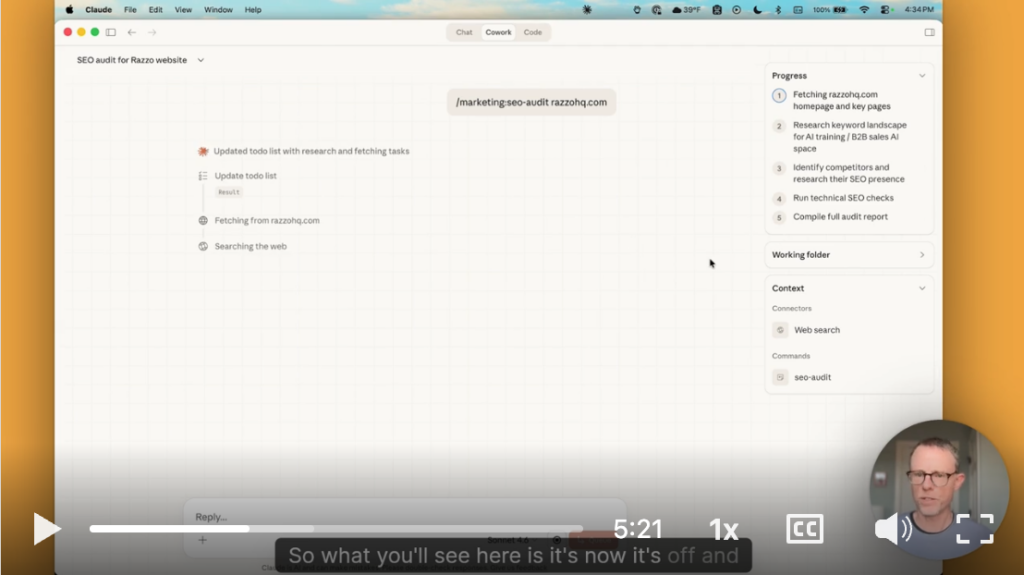
Late last year, the engagement Nicholas got from his content climbed after he stopped having AI completely write his posts. It’s the premise we share at MakeMEDIA: your thoughts have to start with you. Use AI to help extract them, but don’t let it do the thinking for you.
For his own writing, the struggle of moving an idea from a rough concept into something useful turned out to be the point, and a reader can feel the difference between that and an efficient draft.
Video makes the difference even clearer, because the work is hard to fake. When Nicholas shares his screen and walks through a task, you know the expertise came from him and his experience, not from a prompt he ran ten seconds earlier. Visible effort earns attention from the people who think carefully about their business, which is the entire aim of thought leadership that drives authority.
He posts sporadically on LinkedIn and his site, and says so openly. Some weeks once, some weeks not at all. He stopped worrying about the algorithm, and the irregular cadence works in his favor, because the posts that go up are worth reading. That authority and reputation beats a steady stream of forgettable filler, and it is the logic under any durable LinkedIn content strategy.
Where AI Slop Costs You
Generic AI comments can cost you as much credibility as AI posts, sometimes more, because they show up across other people’s networks where more people see them. I watched a Fortune 100 COO get publicly called out for a post so obviously machine-written that it carried every tell of no human thought behind it.
When someone I respected starts recording himself reading a script an AI wrote seconds earlier, I stop following him. For a fractional CTO whose entire product is judgment, that association is expensive.
Referrals Grow From What Your Content Starts

Referrals still matter, and they matter more when there is proof to point to. Nicholas built his early practice on warm connections, including relatives, a brother-in-law, and people from his business network who already trusted him. A cold prospect has nothing to go on when you first hang your own shingle, so you borrow the trust you spent a career earning. Content is what lets that trust travel, because the person making the introduction can point to something concrete.
Do good work for good people and they recommend you, partly because a good recommendation makes them look good. When Nicholas delivers, the person who introduced him gets the credit, which makes them want to introduce him again.
He has watched a niche form on its own this way, in architecture and engineering consulting, without intentionally targeting it. That referral ripple keeps building on itself, which is why a practice that starts slow often looks far healthier in year two than an outbound push that peaks in month three.
Make the Ask Out Loud
One step trips people up, and it tripped me up for years. You have to make the ask out loud. Doing great work and just hoping for a recommendation is wishful thinking with a business card attached.
For technical founders, that ask is genuinely hard. I went to school with engineers. Asking someone for a referral sits well outside the comfort zone of most people who came up through a technical education, so they skip it.
I recently watched a very smart fractional CTO stay silent for months while sitting on a roster of happy clients, never once asking for an introduction. A fractional CRO with the same list would have that ask baked into how they operate.
As an engineer myself, I know awkwardness of asking for business is real, yet the ask is still one of the highest-return hours you have.
Do this today: Make one referral ask out loud, and name the exact introduction you want.
The Two Words That Reset Your Positioning
Two words belong in how you describe your work: organizational change.
Think about why a CEO or a board brings in a fractional CTO at all. Rarely is it to execute a task a junior engineer could handle by following a ticket. If that were the job, they would hire the junior engineer.
They bring you in because something has to change in how the organization works, and they want someone who has led that kind of change before. Language built around organizational change moves you off rate comparisons and onto outcomes, and it filters for companies that understand what they are buying.
The same words can position you as a contractor or as a strategic hire. The buyer hears the difference.
| How You Frame the Role | What the Buyer Hears |
| I implement your tools and systems | A contractor to price against other contractors |
| I lead the organizational change AI demands | A strategic hire worth a premium |
| I bring an AI strategy to the role | Someone who closes a gap they could not name |
Why AI Strategy Belongs in Your Pitch
Any company serious enough to hire a fractional CTO today likely expects some AI strategy to come with the role. Few will put it in the job description. Some will not know how to ask for it. The expectation still sits under the surface of the engagement, and leaving it unaddressed hands the opening to whoever names it first.
Nicholas has seen this kind of moment arrive before. He was employee number one at a marketing agency in 1998, when every business suddenly needed a website. Around 2007 the question became whether you needed to be on social media. Both questions look silly in hindsight, and AI sits at that same point now, only moving faster.
Telling a team to just use AI was reasonable advice eighteen months ago, when the tools were simpler and any use beat none. The skill now lives in the workflows and judgment that operators like Nicholas spent hundreds of hours building. Malcolm Gladwell’s ten thousand hours does not apply here, because the technology has not existed long enough for anyone to log them. Two or three hundred hours of hammering on these tools produces the kind of practical knowledge a company will pay a premium to bring in.
Talk About Where Companies Waste Their AI Budget
One strategy that CEOs want from a Fractional CTO or technology consultant is AI guidance. Companies often treat AI like a routine software rollout. They buy a corporate Copilot license, spend heavily, announce that everybody should start using AI, and then watch almost nothing happen. People draft an email, ask for a slide deck that comes out looking nothing like their own work, get discouraged, and stop.

Focus Where Companies Are Struggling
AI is a general purpose technology, so it asks people to work in a way that feels unfamiliar. That calls for real training and a change in how a team thinks about its own work, not a single hour on the mechanics of a chatbot.
Hand people a tool with no context and they use it like novices, get weak results, and decide AI is a toy that works for coding and not for their own job. That failure is the exact problem a fractional CTO is positioned to solve, and it is a perfect subject for the kind of content that shows a prospect you understand their situation.
Use AI to Interrogate Your Own Thinking
You can use AI in your content without becoming another slop machine, and the trick is direction. Point AI at your own thinking before you produce anything, so it sharpens the work rather than replacing it.
The common assumption is that AI exists to write the post, build the site, draft the email. Some of the most useful applications run the other direction. You let the model ask you questions, pressure-test your logic, and show you the weak points, so that you produce a sharper result.
That is how we built MakeMEDIA. We start with the human and use AI as the tool that pulls the expertise already in your head into the open, through questions rooted in research and in what you actually care about. This article is an example, since it came out of one conversation with Nicholas, and the bottom-up AI content approach behind it works whether you are writing for yourself or for a client.
Another example is a LinkedIn post that went viral for me, a quick note I shared from my daughter’s college graduation. She sat in Radio City Music Hall while nearly every speaker talked about storytelling, and when one mentioned AI, the students booed. I wrote a post connecting that moment to how AI is landing on the people about to enter the workforce.
No AI could have produced this content, because it did not happen to any AI. It was a lived experience that happened to me. The tool only helped me pull out what I was already thinking.
Offer to Deliver This In the First 30 Days

I asked Nicholas what he would have a 25- or 50-person company build first with one quarter to work with. His answer was training and you can use this concept both as a service and as a subject for your content. It serves as a low-friction entry point to start a small engagement that can turn into a bigger project.
It runs top-down and bottom-up at once. Start with the CEO or founder, because the effort dies without them. Then translate that into bottom-up enablement, sitting with individual people to help each one build something in their own role that saves real time. Give someone back fifteen minutes on a task they do every day and the resistance starts to break, because nobody at a small company believes they have spare time.
One step comes even earlier. The CEO can get a sugar-coated version of what’s happening inside their company from leaders who might be afraid to tell senior leaders what they think. An AI readiness survey gives you that map.
Before anyone writes a prompt, Nicholas has clients work through a worksheet that examines their own role for where AI fits. Four questions do most of the work.
| Survey Question | What It Flags |
| What takes too much time? | The tasks worth automating first |
| What is tedious, or what do you avoid every week? | Friction points people will gladly hand off |
| What work do you do the same way every time? | Repeatable workflows, not one-off prompts |
| Could you write it down and hand it to someone else? | A strong candidate for AI |
Once you know what to automate, you add the how, and a one-off prompt becomes a documented workflow you can run again. A workflow you can hand to a client or a team has a repeatable anatomy:
- The purpose it serves and why it exists
- The inputs that change each time you run it
- The stable knowledge it should always carry, like your company, services, and history
- The output format that defines a good result
- The success criteria that tell you it worked
The habit underneath all of it is unglamorous. When I asked Nicholas whether a magic prompt or a boring habit wins, he did not hesitate: boring habit, nearly every time. Record your meetings and put your company knowledge into text files, including the soft things that live only in an executive’s head, so AI can know your business at a depth no prompt will reach. Those same recordings and notes become the raw material for your next piece of content.
“Boring habit, nearly every time.” Record your meetings and turn them into the next piece of content that shows your expertise.
Finding CTO Jobs: Your Next 5 Moves
- Make the ask out loud with every happy client this week, naming the specific introduction you want.
- Reposition around organizational change and the AI strategy you bring, so you attract companies worth your limited time.
- Publish one piece that shows you solving a real problem your prospects face, in your own voice, using content built from your own expertise.
- Package a low-friction entry offer, such as an AI readiness survey, that turns a first conversation into paid work.
- Start the boring habits now: record meetings, write things down, and feed your own knowledge into your tools, so you always have raw material for the next piece.
The fractional CTOs who stay booked are running these five moves during the months when their calendar already looks full.
Fractional CTO Client FAQ
How Do Fractional CTOs Get Clients?
By making their expertise visible before anyone has to take a risk on them. The fractional CTOs who stay booked publish content that shows them solving the exact problems their prospects face, which is what makes a stranger think “I want to work with this person.” Referrals and word of mouth compound on top of that, and the reliable habit is to make the referral ask out loud, which technical founders tend to skip.
How to Get Technology Consulting Clients Without Cold Outreach?
Show your work in public. Publish content that walks through a real problem your prospects have, using the tools they already rely on, so they can judge your thinking before they ever meet you. Ask happy clients for a specific introduction, and package a low-friction entry offer like an AI readiness survey that turns a first conversation into paid work.
Do Fractional CTOs Need to Lead AI Strategy?
Increasingly, yes. A company serious enough to hire a fractional CTO today tends to expect AI strategy to come with the role, even when the job description never says so. Positioning around AI strategy and organizational change filters for better-fit clients and separates you from implementation-only contractors.
What Makes a Company Hire a Fractional CTO?
A need for change at the level of how the organization works, not a task a junior engineer could handle. Companies bring in a fractional CTO for strategic direction, and today that usually includes a credible plan for adopting AI without wasting budget on tools nobody was trained to use.
P.S. The full conversation with Nicholas Tolson is on the Executive Signal podcast, and you can find him on LinkedIn or at razzohq.com. If you know your expertise should be out there but have never found an easy, repeatable way to turn it into content, that is the gap we built MakeMEDIA to close.
Create Authoritative Content Fast
Use MakeMEDIA to create authentic content that highlights your expertise simply by answering questions in a structured conversation designed with your background in mind. It’s like having your own marketing department in your pocket.
