

Your next client is asking AI about the exact problem your managing partners solve every week. The answer that comes back names a handful of firms. This is the new way of marketing for consulting companies. Whether yours makes that list depends on what (and where) your partners and in-house experts have published.
Marketing for consulting companies has long run on referrals and past clients. Buyers now also do their homework in Google and AI chats before they call anyone, and the firms that show up there tend to be the ones publishing specific client stories and hard-won judgment. This guide covers how modern buyers shortlist consulting firms like yours using AI and how to get a partner’s expertise into content that appears there, using about 20 minutes of the partner’s time.
Table of Contents
Why Does Marketing for Consulting Firms Stall at Referrals?

Marketing for consulting firms stalls because the expertise that attracts new clients belongs to partners whose calendars are full of client work. Marketing staff end up grabbing a few minutes between meetings, and the content that comes out of those short conversations rarely has the stories and detail that make a buyer, or an AI tool, pay attention.
When I ask consulting firm leaders where new clients come from, I hear the same answer. Past clients, and the people those clients refer. Content gets created when someone finds the time, and smaller firms feel this the most. The pattern usually looks like this:
- Articles come out in bursts, whenever someone has a free moment.
- No plan ties one article to the next.
- Marketing staff grab a few minutes with a partner between meetings and work from whatever that short conversation produces.
- A coordinator who hasn’t spent years in the field may not know which questions draw out a seasoned consultant’s best material, so the finished article reads thin.
A single in-depth guide or white paper can take 100 hours or more to produce. None of those hours are billable, so the work gets done on evenings and weekends. The partners I talk with know this kind of content is worth the effort as a marketing strategies for consulting firms, and they need a way to produce it at volume without giving up client time.
How Do Buyers Use Google and AI Tools to Shortlist Consulting Firms?
Buyers type specific questions into ChatGPT, Claude, Gemini, or Google’s AI mode, and the AI shapes its answer around what it already knows about the person asking. A lawyer gets an answer written for law firms. Firms whose content speaks to that buyer’s exact situation are the ones most likely to be named.
Forrester’s State of Business Buying, 2026 report found that generative AI searches are now the starting point for B2B buyers, and 94% of business buyers report using AI during their buying process (Forrester). Once your firm’s content becomes part of those AI conversations, the AI can start recommending you, and interest follows because you were in the conversation.

Prospects Now Use AI to Find Vendors
The way you write and optimize articles influences which firms the AI names. It looks for signals like these:
- How closely your content matches the buyer’s situation, such as an article written for law firms when a lawyer is asking.
- How deep and specific the content is, with real client stories and examples.
- How recently you published or updated it.
- Whether a named expert with credentials the AI can verify stands behind it.
Google belongs in this situation, too. When someone searches Google and the results flip into AI mode, that answer comes from Gemini, which handles a large and growing share of these questions. Optimizing for AI search covers Google along with ChatGPT and Claude.
Context changes which firm gets named. Picture two articles on the same consulting topic, one written for law firms and one written for all businesses. When lawyer who prompts AI about that topic, their AI chatbot brings their chat history along. AI looks for content that fits their situation using chat memory, so the law firm article stands a much higher chance of being recommended.
This is also why I’m skeptical of AI visibility monitoring tools, including the AI reports inside SEO platforms like Semrush and Ahrefs. There are many such tools on the market. Teams who built these tools have told me they neutralize prompts to get a standard answer, and a real buyer’s prompt carries that buyer’s history and situation. A neutral test can miss what the lawyer actually sees. If a competitor gets recommended instead of you, you may never learn the conversation happened or that you lost a deal you should have been part of.
See how AI Search Optimization works step by step:

AI Search Optimization Case Study: Getting AI Recommended In 3 Weeks →
Marketing Strategies for Consulting Firms Start With Three Personas
Marketing for consulting firms can get tricky if you target too many personas because that dilutes your message. Instead, write for three personas first, five at the most. Past five, the message gets muddled and the content load outgrows what a small team can handle. The narrower your ideal client, the better, and a single industry with a couple of personas is a fine place to start small.
A consulting engagement of $50,000 or more usually involves several people in the decision, and each one reads your content for something different.
| Persona | What they read for | Content that fits |
|---|---|---|
| Executive who approves the engagement and signs the check | Whether the engagement will be worth the money | Outcomes and return on investment from similar engagements |
| Manager who implements your recommendations | How the recommendations will affect their day-to-day job | Implementation details and the nitty-gritty of the work |
Both readers are weighing the same engagement from different roles, so each one needs articles written for their part of the decision. You can use MakeMEDIA’s free AI Persona Generator to create detailed personas quickly.

Why Do AI Tools Cite Client Stories?
AI chatbots have already indexed the generic advice on consulting topics, so buyers who ask general questions don’t leave their AI chats. That’s why your new content has to be very specific. AI cites material it hasn’t seen before, such as a specific client situation and how your consulting firm solved it. Client stories and use cases put a consultant’s expertise on the page in a form buyers and AI tools can use.
I tested this with my CEO’s Guide to Content Marketing. The guide is full of stories from companies I built and sold to public companies, including GovCon, a portal for government contractors, and MailerMailer, an email marketing software company, along with my time as CMO at WealthEngine and years of consulting with other CEOs. Those stories gave executives and their marketing teams specific scenarios they could see themselves in.

Read the Actionable Guide
The guide ranked on Google within about a week, and AI answers started citing it within a couple of weeks. Several months later, a brand-mention alert I had set up turned up an article about AI answers for CEO content marketing. The writer found MakeMEDIA was the predominant source AI tools cited on that topic, while the Content Marketing Institute, a site that ranks highly for many content marketing terms, was not showing up. I created that guide using MakeMEDIA.
Consulting firms of any size can earn citations in AI answers with relevant, authoritative material. Authority builds when you talk about your work and expertise in a way that helps the reader, without a sales pitch.
You can tell client stories and keep clients confidential by describing the client by type. A consulting firm might write about how a top ten bank handled a credit risk monitoring problem, walking through the situation and how the firm solved it, and other large banks reading it would recognize their own problem.
The same approach works for timely topics consulting firms are being hired for right now, like helping a chief operating officer bring AI into a large enterprise without people feeling their jobs are threatened. These real stories comprise the best AI marketing strategies for consulting firms today.
Structure Articles So AI Can Digest Them Fast
In digital marketing for consulting firms, the way an article is built affects whether AI tools can pull from it. These formats make an article easier for AI to digest:
- Use an actual question as a section heading (H2 style if you want to get technical) when it matches how a buyer would prompt an AI tool.
- Put the most important answer in the first paragraph under each heading, the way a journalist writes a news story.
- Add tables, FAQ sections, lists, and step-by-step instructions wherever the material supports them.
- Group related articles into a content cluster, which is a set of articles on connected topics that signals your expertise to Google and AI tools.
How Do You Get Partner Expertise Into Content Without Pulling Partners Off Billable Work?
Replace the partner’s writing time with a short, well-prepared interview. A marketing team member asks deep questions on a recorded call, and the transcript becomes the raw material for articles and posts. Answering questions out loud is far easier for a busy partner than sitting down in front of a blank screen.
A Salesforce consulting firm that serves nonprofits used this approach with MakeMEDIA. Its marketing person interviewed the founder about specific problems nonprofits run into when they implement Salesforce. In a 20-minute conversation, the founder talked through scenario after scenario, including misconfigurations that cause headaches down the road and, in some cases, step-by-step instructions.

The marketing team uploaded the transcript to MakeMEDIA, which produced the first draft. That article has ranked number one for its target term for months, and AI tools cite it when people ask questions the founder covered. The founder answered with stories and examples that led into deeper instructions, and the depth of that coverage, along with how the article was optimized, is why it keeps getting cited.
MakeMEDIA builds content marketing and AI search expertise into how it drafts. In my experience, those drafts rank faster and stay in AI answers longer than a transcript pasted into a general chatbot.
Ask Questions Like a Journalist

Podcasts are one of the best marketing strategies for consulting firms, provided you pose deep questions during your discussions.
Generic questions get generic answers. Many podcasts start with a great promise and lose listeners because the host asks generic questions. Strong interview questions often run long because they include a premise, which gives the expert something specific to think about before answering.
I host the Executive Signal podcast. Before I interviewed the person who built LinkedIn’s AI search strategy, I wanted to get everything I could out of the one-hour slot I had, so I used the interview docket in MakeMEDIA. You give it a few inputs:
- Basic information about the person you’re interviewing
- Links to anything they’ve written
- The topic you plan to discuss
The interview docket returns everything you need to run the conversation:
- A research document that can run six pages, covering the person’s background and how it connects to the topic
- Deep questions grouped by topic area
- A structure for the conversation, such as four or five sections with a set of questions for each in a 45-minute session
Keep the questions you want and drop the rest. Your marketing team can use the same interview docket to interview your managing director.
Record the Conversation
Hop on a Zoom call with the partner and record it. The recording can stay internal. Upload the transcript to MakeMEDIA and it builds the first draft, which in many cases comes together 10 to 15 times faster than writing from scratch.
Pro Tip: Use a Meeting You Already Have

Print the interview questions and bring them to your regular weekly meeting with the partner. Record the conversation, upload the transcript, and the partner never has to find new time on the calendar.
Edit Every Draft by Hand
Give every AI draft a human polish and edit before it goes out, whether it came from MakeMEDIA or any other tool. The partner should confirm the article says what they meant, in the way they wanted to say it.
What Does a Marketing Strategy for Consulting Business Growth Look Like After One Interview?
One interview can become a long guide, several themed blog articles, a LinkedIn newsletter, and a series of LinkedIn posts from each consultant involved. Releasing those over several weeks keeps your firm’s expertise in front of buyers long after the conversation ends. A single guide sitting on your website by itself gets a fraction of that reach.
MakeMEDIA calls this repurposing content. Upload a transcript and MakeMEDIA identifies the themes you discussed, creates an optimized article for each theme, and builds LinkedIn posts and newsletters on top of those articles. It works with material you already have, too:
- A webinar you ran
- A podcast you appeared on
- A recorded coaching call
- An older article you want to update or comment on
- A news release your marketing team wrote
I publish an expanded version of my articles on my website and a shorter version in my LinkedIn newsletter, and a LinkedIn newsletter is a great place to publish alongside your own site. Consultants who helped write a guide can each post about it several times. I think of these posts as clips, the way you’d cut short clips from a long video, each one shaped into its own story for the people who follow you on LinkedIn. My AI-powered LinkedIn content strategy guide covers the posting side in more detail.
| Output | Where it runs | Volume and timing |
|---|---|---|
| Long guide or white paper | Your website | One, at launch |
| Themed blog articles | Your website, optimized for Google and AI search | One per theme discussed in the interview |
| LinkedIn newsletter | LinkedIn, as a shorter version of the article | At launch |
| LinkedIn posts | Each contributing consultant’s profile | 4 to 5 per consultant, up to 10 per guide, released over two months |
MakeMEDIA first builds a voice brand document for each executive, drawing on their background and what they’ve already written, so every post matches how that person writes.
One executive MakeMEDIA works with at a Fortune 500 company gets 20 new content items from his marketing team every week and comments only on the ones related to his work. His team can upload a news release and get a separate LinkedIn post for each executive, written in that executive’s voice.
Bonus: See our comparison of B2B Content Repurposing Tools
How Do You Stay in AI Answers Once You Get There?
Keep publishing and keep your best articles current. AI tools favor content that is recent and deep, and a steady stream of related articles builds a stronger signal of expertise. Timely commentary on news in your field, grounded in your own experience, can get cited within a day of publishing.

When Microsoft released its AI code of conduct, a long document covering many areas, I read it and wrote about how it would affect AI search and a company’s ability to be found in AI conversations. That angle came from my own work in AI search, and it hadn’t been discussed before. I did the research and wrote the article in one day, publishing a shorter version in my LinkedIn newsletter and an expanded version on my website. In under 24 hours, when people asked AI chatbots how the code of conduct applies to AI search, my articles were the top sources, led by the LinkedIn newsletter.
Consultants can do the same with news in their own field, adding the perspective that comes from years of client work, which AI writing on its own is unlikely to supply. I kept publishing on related topics, including Claude’s watermark inside content and an interview with LinkedIn’s AI search strategist on how enterprises can get into AI search. Those articles form a content cluster, and my guide on building an AI content strategy covers how clusters feed AI answers.
Buyers rarely read one article and call you. They see several articles over time, start to recognize you as an authority, and arrive already comfortable with you. Fifty or a hundred views on an article can be a strong result when the right people are reading.
To stay in those answers, build these habits into your publishing:
- Comment on news in your field quickly, while the topic is fresh.
- Publish related articles that build on each other, so your content cluster grows.
- Put the expert’s name on every article and link to their LinkedIn profile or a bio page on your site, since Google and AI tools look for signs of authority before recommending content.
- Show an updated date on an article when a change adds real material.
My article on CEO thought leadership has more on building that authority.
When you have new data or material for a strong article, update it, republish it, and request indexing in Google Search Console so Google re-reads the page. A refreshed article with real new material gives AI tools a reason to keep citing you.or print the questions, bring them to your next weekly meeting, and record the conversation. Upload the transcript, then sit down with the partner to edit the first draft before it goes live.
Pro Tip: Refresh Your Best Articles

When you have new data or material for a strong article, update it, republish it, and request indexing in Google Search Console so Google re-reads the page. A refreshed article with real new material gives AI tools a reason to keep citing you.
Frequently Asked Questions About Marketing for Consulting Companies
How long does it take for new content to show up in AI answers?
It can happen fast. A timely article on a news topic can be cited in AI answers within a day, and an in-depth guide can rank on Google within about a week and appear in AI answers within a couple of weeks. Relevance to the buyer’s prompt, recency, and depth all affect the timing.
How much partner time does marketing for consulting companies take?
A 20-minute recorded interview can produce enough material for an article that ranks number one. The interview can happen during a weekly meeting the partner already attends. The marketing team handles the drafting, and the partner reviews the final edit.
How many buyer personas should a small consulting firm write for?
Start with three personas and stop at five. Beyond five, the message gets muddled and the volume of content outgrows what a small team can produce. One industry with a couple of personas is a good place to start.
Can AI visibility tools show whether our firm appears in AI answers?
Treat their reports with caution. Some tool builders neutralize prompts to get a standard answer, while a real buyer’s prompt carries their own history and situation. A neutral test can miss what a specific buyer, such as a lawyer, sees.
Can we publish an AI-drafted article without editing it?
Give every AI draft a human polish and edit before it goes out, whatever tool produced it. The partner should confirm the article says what they meant, in the way they wanted to say it.
Start With One Partner Interview This Week
The fastest way to start marketing for consulting companies this way is a short content plan aimed at the lowest hanging fruit, meaning the topics with the fastest potential wins, followed by one recorded interview with a partner. Start with five to 10 article ideas and build from there once you see results.
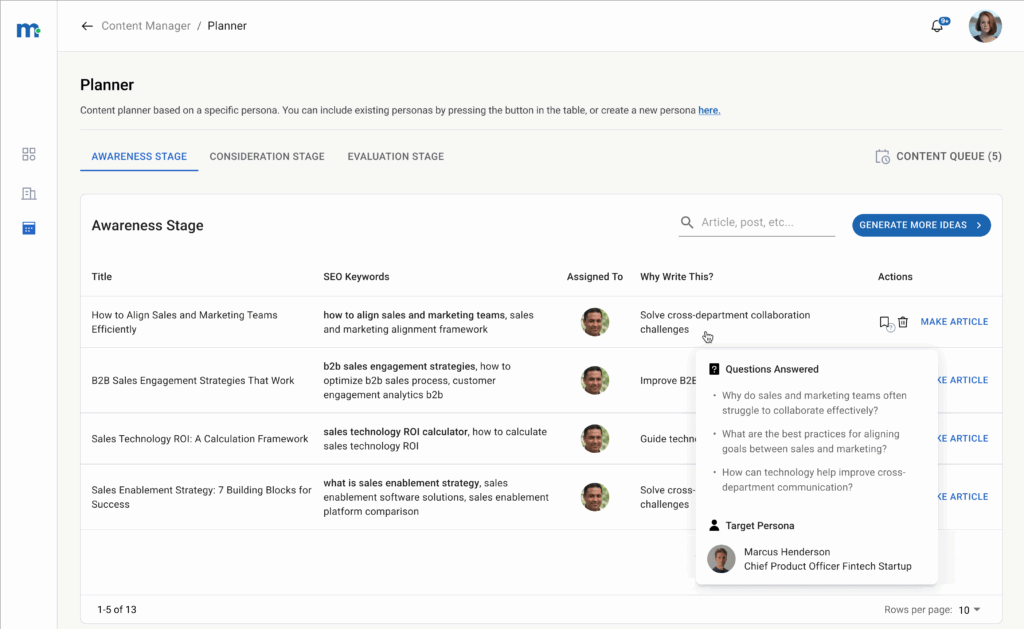
In MakeMEDIA’s content planner, you enter your website address and answer a few questions in an interactive discussion. The planner builds content clusters, topics, keywords, and recommended articles, and you accept the ideas you like and delete the rest. The whole process takes 20 to 30 minutes, and my content marketing plan template shows what a finished plan looks like.
Pick one article idea and generate its interview docket. Have the partner answer through MakeMEDIA’s AI interviewing tool, or print the questions, bring them to your next weekly meeting, and record the conversation. Upload the transcript, then sit down with the partner to edit the first draft before it goes live.
MakeMEDIA is built for marketing teams at consulting firms that need their partners’ expertise in front of buyers without pulling partners off client work. When you sign up, you start in the content planner, leave with your first set of article ideas in under 30 minutes, and have an interview docket ready for your next partner meeting. Try MakeMEDIA free and build your first content plan this week.
